
Why Perineural Injection Therapy (PIT) Works So Well for Chronic Pain

You've tried the pills, physical therapy and maybe even tried the cortisone shot that helped for three weeks and then quietly stopped working. If your pain keeps circling back no matter what you throw at it, there's a good chance nobody has looked at the actual source yet: the nerve itself. That's where Perineural Injection Therapy comes in, and it's why so many patients and the providers who treat them are paying attention to it right now.
At Learn Neural Therapy, we teach clinicians how to perform this technique, and one question comes up constantly: Why does something this simple work so well when bigger interventions fail? Let's break it down in plain terms!
What is Perineural Injection Therapy?
Perineural Injection Therapy, shortened to PIT, is a treatment that places a small amount of dextrose (basically sugar water) just under the skin, right next to an irritated nerve. No scalpel. No general anesthesia. Just a series of shallow injections placed along the path of the nerve that's causing trouble.
The technique was developed by Dr. John Lyftogt, a physician in New Zealand who noticed something strange while treating tendon injuries. When he injected dextrose near a painful area instead of directly into it, patients felt relief almost immediately, and it lasted. That discovery eventually became what we now call PIT, or neural prolotherapy.
How PIT Differs From Traditional Prolotherapy
People lump PIT in with regular prolotherapy, but they're not the same thing. Traditional prolotherapy uses a stronger dextrose solution and goes deep, targeting ligaments and tendon attachments to encourage tissue repair.
Perineural injections stay shallow and go after the nerve itself, not the joint. Think of it this way: one treats the scaffolding, the other calms the wiring.
The Science: Why Perineural Injection Therapy Works So Well
Here's the part that surprises most people. Chronic pain isn't always about damaged tissue anymore. Sometimes the original injury heals, but the nerve near it stays stuck in "alarm mode." Small sensory nerves called C-fibers can lose proper blood flow after an injury. Starved of oxygen and glucose, these nerves start leaking inflammatory chemicals like substance P and calcitonin gene-related peptide. Those chemicals keep firing pain signals to the brain long after they should have stopped.
The Pain Loop that Won't Quit
It turns into a cycle. Inflammation causes swelling around the nerve. Swelling reduces blood flow even more. Reduced blood flow triggers more inflammation. Round and round it goes, which is exactly why so many chronic pain patients say their pain has "a mind of its own."
Dextrose interrupts that loop. When it's injected near the nerve, it seems to restore the energy supply the nerve was missing and calm the inflammatory response. Patients feel a change within minutes of their first session, though it usually takes several treatments before the relief sticks around for good.
What Chronic Pain Conditions Respond Best to Perineural Injections
Not every type of pain responds the same way, and that's worth knowing before you get your hopes up or write the treatment off. Here's how PIT tends to perform across common conditions, based on current clinical research and case reporting!
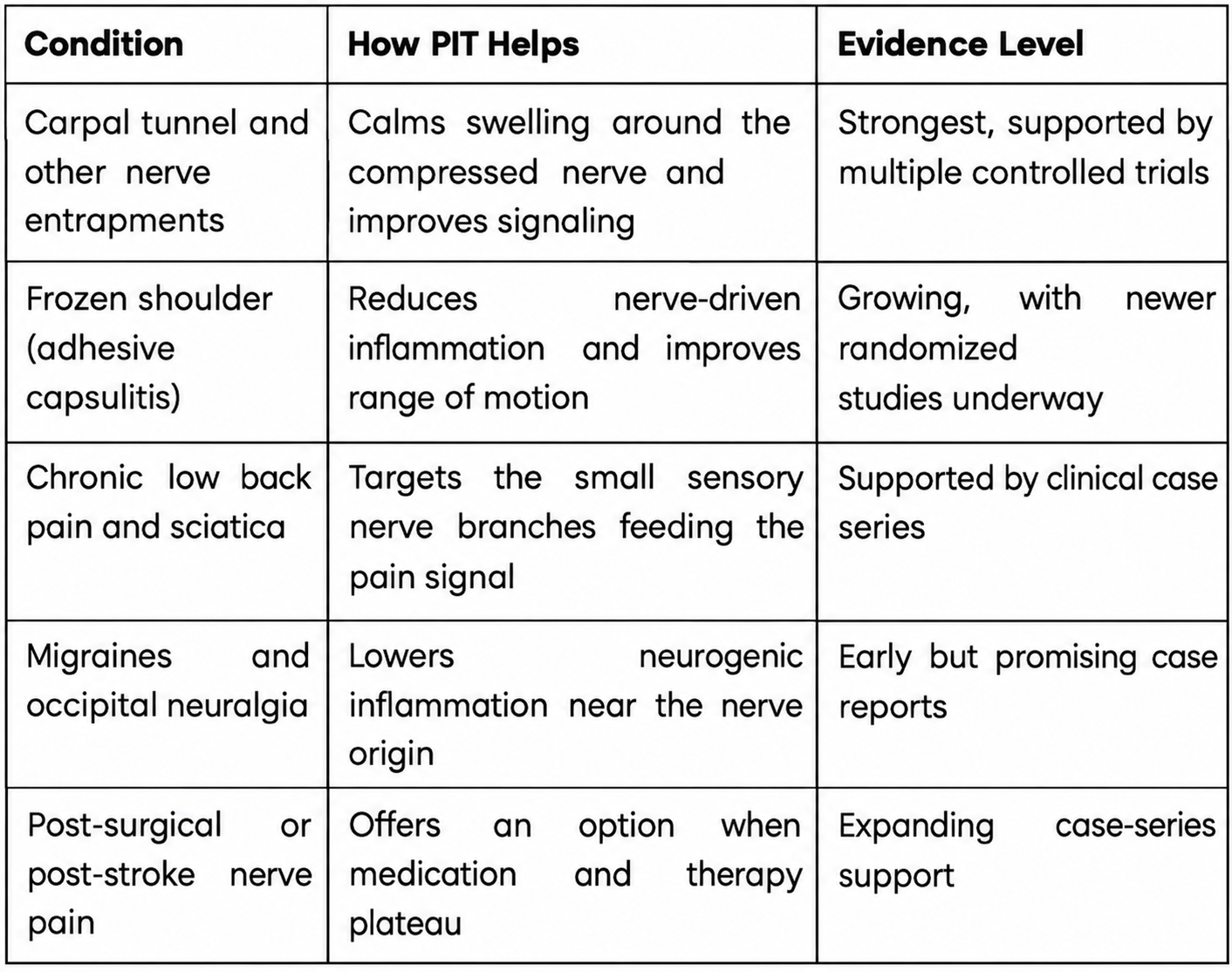
If your pain fits one of these categories and nothing else has worked, PIT is worth a real conversation with a trained provider.
Neural Therapy Benefits Beyond Just Pain Relief
Pain relief gets the headline, but the other neural therapy benefits are what keep patients coming back. There's no general anesthesia. There's almost no downtime. Most people walk out of the office and go about their day. Side effects, when they happen, are usually mild, a little bruising, maybe some soreness that fades in a day or two.
It's also not an opioid, and it doesn't compete with the treatments you're already using. You can usually keep taking your anti-inflammatory medication. The one exception worth knowing: patients on chronic opioids tend to respond more slowly, likely because opioids compete with dextrose for the same receptor site on the nerve cell.
PIT vs. Cortisone: What's the Real Difference?
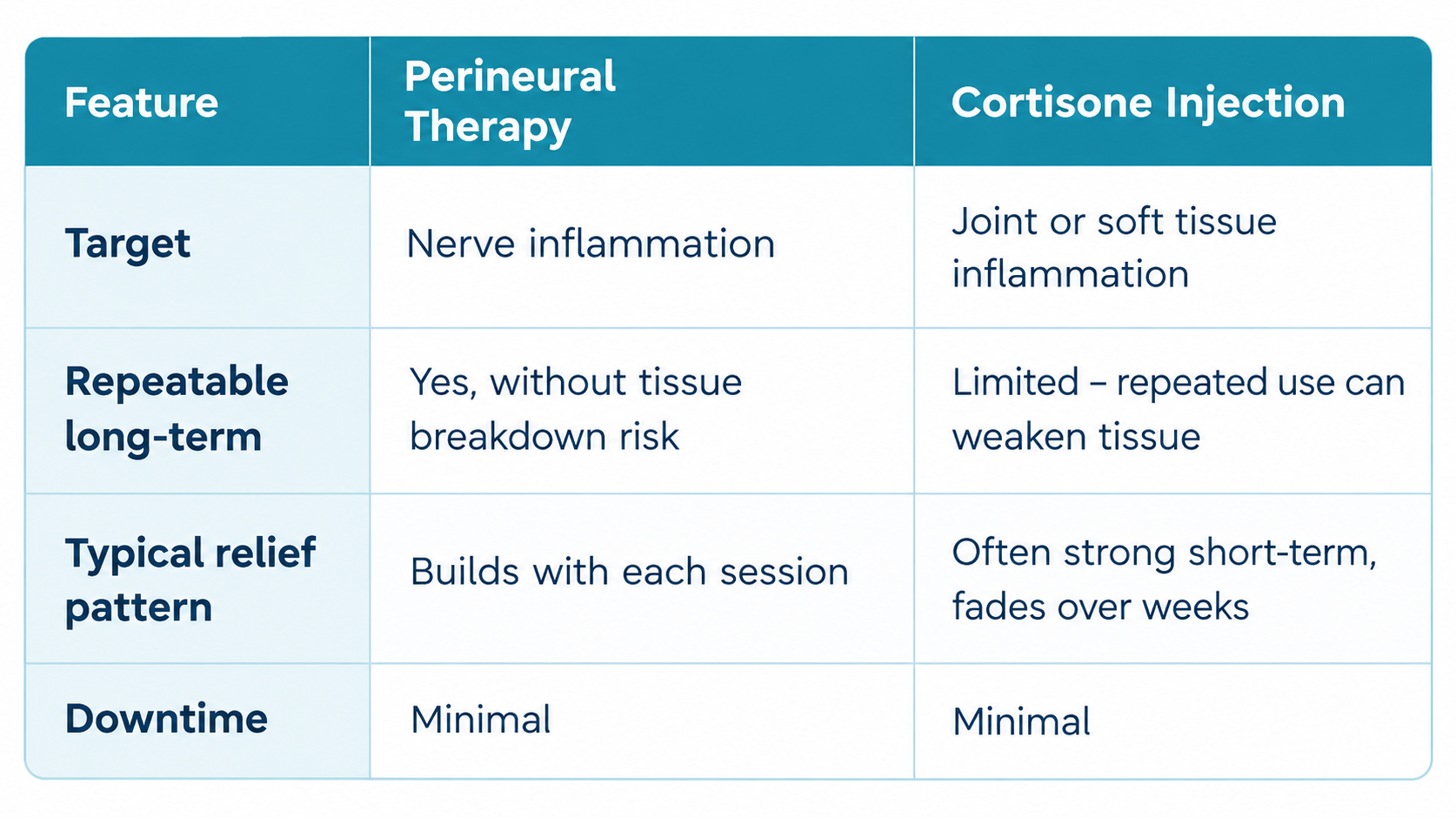
A 2025 study of four randomized trials and one quasi-experimental study with 212 patients found that 5% dextrose improved function better than corticosteroid injections after three months. It also had fewer reported side effects.
What to Expect During & After Neural Therapy Injections
A typical PIT session takes well under an hour. The provider maps out the nerve pathway causing your pain, then places a series of shallow injections along it using a very thin needle, similar in size to an acupuncture needle. It stings a bit, nothing dramatic.
Here's something worth knowing going in: after your very first treatment, the relief might only last a few hours. That's normal, not a sign that it's failing. With each following session, the pain tends to return less intensely and stay away longer. Most patients need somewhere between four and six sessions, spaced roughly one to two weeks apart, before they notice lasting change.
Who Might Not Be a Great Fit
We'd rather be upfront about this than oversell it. Perineural injections work well for many people, but the research is still developing for some conditions, and results vary from patient to patient. Insurance in the United States often classifies it as unproven, so it's frequently an out-of-pocket treatment. Patients with allergies to local anesthetics may need a modified approach. And if you're dealing with something that needs urgent surgical attention, PIT isn't a substitute for that. A good provider will tell you honestly whether you're a candidate instead of promising results they can't guarantee.
PIT Injection Training: How Providers Learn This Technique
For clinicians reading this, here's the part that matters to you. Learning PIT isn't just watching a video and picking up a needle. Real PIT injection training means mastering the anatomy of superficial sensory nerves, understanding how neurogenic inflammation actually behaves, and practicing injection placement under supervision until it's second nature.
That's exactly what our courses at Learn Neural Therapy are built around. Whether you're brand new to the technique or refining your skills, our workshops cover the science, the hands-on injection practice, and the practical tools to start helping patients the following week. Physicians, nurse practitioners, PAs, and chiropractors have all gone through our upper body and lower extremity courses and come away confident enough to use the technique immediately in their own clinics.
Adding neural therapy injections to your practice isn't just about learning a new skill. It's about offering patients a non-opioid, low-risk option when everything else has plateaued.
The Bottom Line
Chronic pain that won't respond to the usual playbook doesn't mean you're out of options, it might just mean the nerve itself hasn't been treated yet. Perineural Injection Therapy gives patients a low-risk path forward and gives providers a genuinely useful tool to offer when nothing else has landed.
If you're a patient, ask your provider whether they're trained in this technique. If you're a clinician ready to add it to your practice, Learn Neural Therapy's hands-on courses are the place to start. Reach out today and see which class fits where you are in your journey.
FAQs
Is Perineural Injection Therapy painful?
Most patients describe it as a mild sting, similar to a small pinprick. It's far less uncomfortable than a deep joint injection.
How many PIT sessions will I need?
Most people need four to six sessions, though this depends on how long you've had the pain and how severe it is.
Is neural prolotherapy the same thing as PIT?
Yes, neural prolotherapy and Perineural Injection Therapy refer to the same technique. You may also hear it called the Lyftogt Technique.
Does insurance cover perineural injections?
Coverage varies and is limited in the U.S. Many patients pay out of pocket, so ask your provider about the cost upfront.
Can I combine PIT with other pain treatments?
Generally, yes. It works alongside physical therapy and most medications, with the exception of chronic opioid use, which can slow your response.
How do I get trained in Perineural Injection Therapy?
Hands-on courses like the ones offered through Learn Neural Therapy walk providers through anatomy, technique, and live practice so you can start using it in your clinic right away.