
What Conditions Are Perineural Injections Commonly Used For?

Picture this: a patient walks into your office for the fifth time this month. Same shoulder. Same dull, burning ache. You've tried the usual playbook, and nothing sticks. If that scene sounds familiar, you're not alone. Chronic nerve pain frustrates patients and clinicians alike, and it's exactly why more providers are turning to perineural injections. This simple, needle-based technique targets irritated nerves directly, bringing relief when other treatments fall short.
At Learn Neural Therapy, we've watched this approach change how clinicians think about pain. So what exactly do perineural injections treat, and why are so many providers adding this skill to their toolkit? Let's break it down!
What Are Perineural Injections?
Perineural injections involve placing a small amount of dextrose solution just under the skin, right next to an irritated nerve. Most providers use a 5% dextrose mix, though the exact recipe can vary. The goal isn't to numb the area or mask pain. It's to calm the nerve down at its source.
You might also hear this called "neural prolotherapy" or the "Lyftogt Technique," named after Dr. John Lyftogt, the New Zealand physician who developed the method. It's a cousin of standard prolotherapy, but there's a key difference. Regular prolotherapy targets weak ligaments and tendons. Perineural injections go straight for the nerve itself.
How Do Perineural Injections Actually Work?
Here's the short version. When a nerve gets irritated, it becomes hypersensitive. It fires off pain signals even when there's no real threat. Dextrose injected near that nerve seems to change its chemical environment, calming down a receptor called TRPV1 and helping the nerve's membrane settle back into a normal resting state. Once that happens, pain signals quiet down. Patients notice a difference within the same visit. This is one reason neural therapy injection techniques have caught on so quickly among pain-focused clinicians.
Conditions Perineural Injections Are Commonly Used For
So where does this actually apply in practice? Perineural injections cover a surprisingly wide range of conditions. Below, we've grouped the most common ones by category.
Muscle & Joint Pain
This is where perineural injections show up most in daily practice.
Chronic low back pain: a leading reason patients seek out this treatment.
Knee osteoarthritis and anserine bursitis: especially in patients who want to avoid surgery.
Rotator cuff injuries and supraspinatus tendinopathy: common in athletes and desk workers alike.
Hip, gluteal, and sacral pain.
Coccydynia (tailbone pain), which is notoriously hard to treat with anything else.
Pinched & Irritated Nerves
Nerve entrapment conditions respond especially well to this approach, and the research backing it up keeps growing.
Carpal tunnel syndrome, including cases that come back after surgery.
Ulnar neuropathy at the elbow.
Radiating neck pain, tied to nerve irritation in the cervical spine.
General pinched nerve or nerve compression symptoms.
Pain After Surgery or Injury
Lingering pain after total knee replacement.
Scar-related pain following any surgical procedure.
Whiplash injuries, where nerve irritation can drag on for months.
Pelvic and Specialty Pain
Pudendal neuralgia and other pelvic pain syndromes.
Complex regional pain syndrome, though evidence here is still limited to case reports.
Newer, Still-Developing Uses
Fibromyalgia, currently being studied in active clinical trials.
Migraine-related nerve pain.
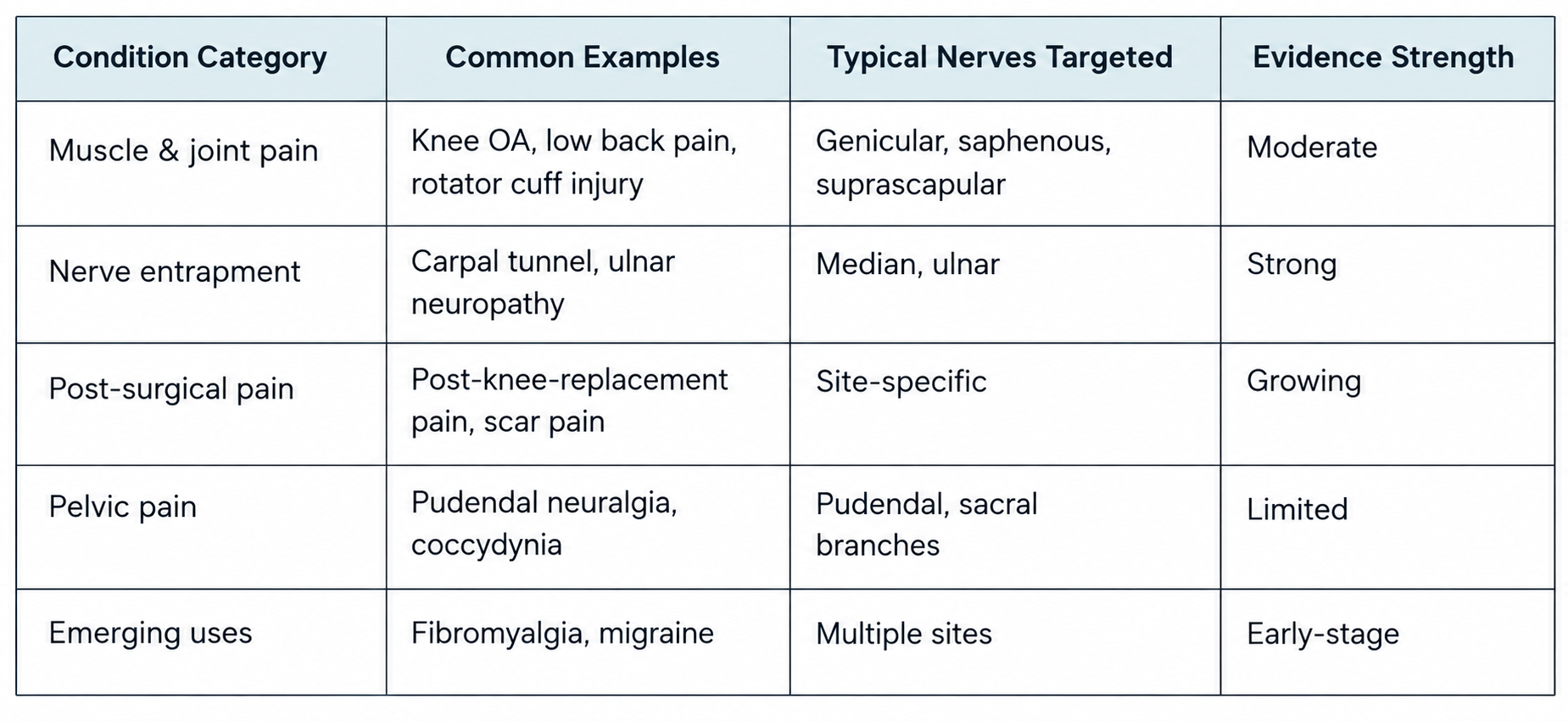
Here's a quick reference table to keep things organized:
Why Clinicians Are Adding This to Their Practice
Ask any provider who uses perineural injections regularly, and they'll probably tell you the same thing: patients like it. It's non-opioid, it's low-tech, and it doesn't require an expensive setup. Many patients feel improvement the same day, which builds trust fast. It also fits neatly into several scopes of practice, so naturopathic doctors, chiropractors, MDs, acupuncturists, and nurse practitioners can all learn it.
What the Research Actually Shows
We'd rather be upfront than oversell this. The strongest evidence right now points to carpal tunnel syndrome and ulnar neuropathy, backed by real randomized trials. Knee osteoarthritis and bursitis have solid support too. Uses like fibromyalgia and complex regional pain syndrome are promising but still early. That kind of honesty matters, especially with a treatment involving needles and patient trust.
One more thing worth mentioning: not every insurance plan covers perineural injections yet. Some players still call it "investigational." That's changing as more trials get published, but it's a fair question patients will ask, so it helps to have an honest answer ready.
How to Learn Perineural Injection Techniques
Knowing what perineural injections treat is one thing. Actually performing them safely is another. That's where hands-on neural therapy training comes in. You can't learn needle placement, dosing, or nerve anatomy from a textbook alone. You need practice, feedback, and a real instructor watching over your shoulder.
That's exactly what Learn Neural Therapy offers. Our courses walk providers through everything step by step, starting with foundational neural therapy injection concepts and building up to specific techniques for the upper and lower extremities. Classes cover anatomy, safety protocols, billing, and plenty of hands-on injection practice. Most of our courses also qualify for continuing education credit through NANCEAC and NCCAOM, so your training time counts toward your license requirements too.
Who Can Take This Training?
Good news: you don't need to be a physician to learn this skill. Our classes welcome:
Medical doctors and doctors of osteopathic medicine.
Naturopathic doctors.
Nurse practitioners and physician assistants.
Chiropractors.
Acupuncturists.
Dentists (for head and neck applications).
Any provider with injection scope of practice.
Ready to Add This Skill to Your Practice?
Perineural injections come up as a real, practical relief for patients dealing with chronic pain that just won't budge, from stubborn back pain to nerve entrapments that haven't responded to anything else. But like any injection-based skill, it takes proper training to do it well and do it safely. That's the whole reason Learn Neural Therapy exists. We built our courses for real clinicians who want real results for their patients, not just theory. Whether you're brand new to injection therapy or looking to sharpen skills you already have, there's a class built for where you're at.
Check out our upcoming neural therapy training dates and find the course that fits your practice. Your next patient with stubborn nerve pain might just be waiting for you to learn this.
FAQs
What conditions respond best to perineural injections?
Carpal tunnel syndrome and ulnar neuropathy currently have the strongest research behind them. Musculoskeletal pain in the knee, back, and shoulder also shows consistent, reliable results in clinical settings.
How many sessions does someone usually need?
It depends on the nerve involved and how long the pain has been going on. Many patients need several sessions spaced a week or two apart, though some notice relief after just one visit.
Are perineural injections the same as prolotherapy?
Not quite. Regular prolotherapy strengthens ligaments and tendons. Perineural injections target the nerve directly. Both use a dextrose solution, but the goal and placement are different.
Does insurance cover perineural injections?
It varies a lot by provider and plan. Some insurers still classify it as investigational, so it's worth checking coverage case by case.
How do I get trained in this technique?
Start with a hands-on course built for your scope of practice. Learn Neural Therapy provides both in-person and virtual options designed to get you injecting confidently and safely.