
Top Benefits of Neural Therapy Injection Training for Practitioners

For practitioners, neural therapy injection training gives you a precise, low-risk way to treat chronic pain by resetting the autonomic nervous system; using small injections of 1% procaine to neutralize the electrical "interference fields" that keep patients stuck in pain cycles no other treatment has fixed.
What Is Neural Therapy?
Traditional treatments chase where pain is felt; Neural Therapy fixes why the nervous system keeps firing.
It is a specialized injection technique that targets the autonomic nervous system (ANS) using low-dose local anesthetics; typically, 1% procaine. Instead of temporarily numbing an area, these targeted micro-injections restore the electrical membrane potential of hyper-sensitized cells damaged by old scars, trauma, or infections ("interference fields"). This foundational concept is a key focus in Neural Therapy Injection Training, where practitioners learn how to identify and treat these underlying dysfunctions.
By neutralizing these chronic electrical disruptions, Neural Therapy effectively resets the ANS, short-circuiting persistent pain signals. As an advanced chronic pain treatment, it is the definitive physiological reset for complex, treatment-resistant pain cases that have failed standard modalities.
Core Mechanism: Why It Works
Here is what is happening under the skin.
A healthy nerve cell maintains an electrical resting membrane potential of -70 to -90 mV. Trauma, surgeries, or chronic infections drop this potential to a volatile -20 or -30 mV. This leaves the cell chronically depolarized, forcing the nerve into a state of constant, low-level firing that floods the autonomic nervous system (ANS) with persistent pain signals.
Neural therapy precisely injects low-dose procaine into this dysfunctional tissue. By briefly blocking sodium channels, it hyperpolarizes the nerve membrane, allowing it to repolarize back to its healthy resting state. The autonomic feedback loop resets, instantly quieting chronic pain.
What Is an Interference Field?
An interference field is a damaged or chronically irritated tissue segment, a scar, a ganglion or an old infection site that keeps sending abnormal signals into the autonomic nervous system.
Think: a C-section scar, a root canal, a childhood tonsillectomy. Any of these can quietly disrupt ANS function for years, causing referred pain in completely unrelated areas of the body.
Neural therapy treatment neutralizes that field directly. A few precise injections into or around the scar tissue act as an electrical reset button. Many patients notice a shift in symptoms within minutes of treatment.
That's the clinical promise of neural reset therapy, and it's why practitioners trained in this technique can help patients no one else has helped.
Neural Therapy vs. Other Injection Techniques
Here's a simple comparison so you can see exactly where neural injection therapy fits relative to techniques you may already use:
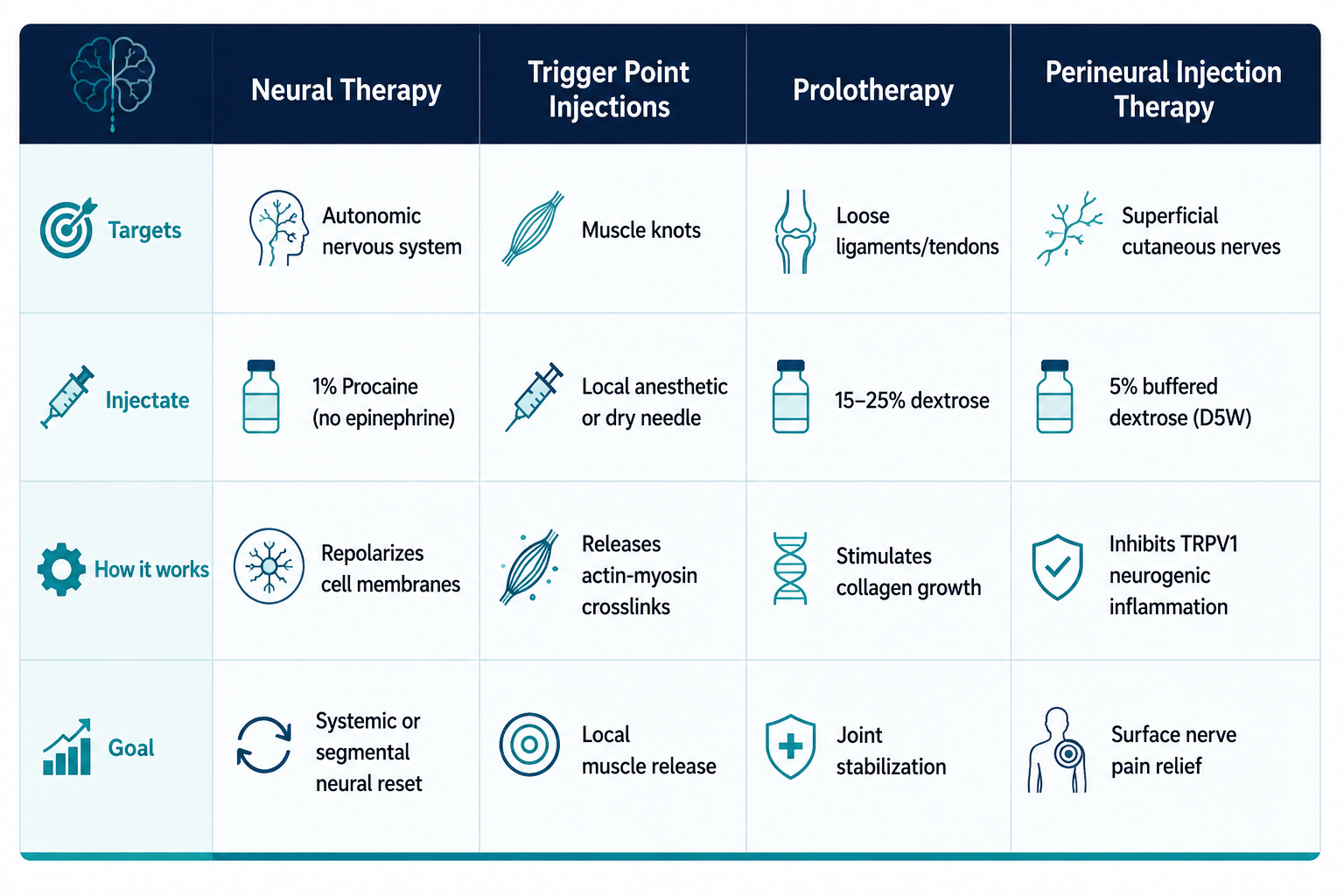
Neural therapy treatment is the only modality on this list that targets the electrical root of chronic pain; not just the structural one. That's the gap it fills.
Top Benefits of Neural Therapy Injection Training for Practitioners
Investing in specialized training for Neural Therapy injections can transform your clinical outcomes. Here are the top seven benefits for practitioners:
1. Rapid and Drastic Pain Relief
One of the most rewarding aspects of Neural Therapy is the "lightning reaction". Practitioners frequently witness patients experience immediate, total relief from long-standing chronic pain during the injection session. Adding this to your toolkit allows you to provide instant gratification and profound relief to suffering patients.
2. Targeting the Root Cause, Not Just Symptoms
While conventional medicine often relies on daily pharmaceuticals to mask symptoms, Neural Therapy resets the autonomic nervous system (ANS). By treating interference fields, such as old surgical scars or trauma sites that leak abnormal electrical signals, you resolve the underlying autonomic dysfunction causing the illness.
3. Highly Complementary to Existing Modalities
Neural Therapy integrates seamlessly with various medical backgrounds. Whether you practice chiropractic care, osteopathy, naturopathy, physical therapy, or conventional pain management, these injection techniques enhance your existing protocols, making your current treatments even more effective.
4. Minimal Side Effects and High Safety Profile
Because the therapy utilizes low-concentration local anesthetics rather than heavy cortisones or opioids, the risk of adverse neural therapy side effects and complications is remarkably low. Training ensures you master precise anatomical placement, allowing you to deliver a safe, non-addictive, and minimally invasive intervention.
5. Expanded Scope of Treatable Conditions
Mastering these injection techniques allows you to treat a vast array of complex, treatment-resistant conditions. Your scope will expand to successfully manage migraines, phantom limb pain, chronic pelvic pain, tinnitus, post-surgical pain, and complex regional pain syndrome (CRPS).
6. Boosted Patient Retention and Referrals
In a medical landscape where patients are actively seeking alternatives to surgery and long-term medication, offering Neural Therapy sets your practice apart. Exceptional, fast-acting results naturally lead to high patient satisfaction, driving powerful word-of-mouth referrals and practice growth.
7. Enhanced Diagnostic Precision
Neural Therapy double-functions as a brilliant diagnostic tool. A practitioner's ability to inject a suspected interference field and observe an immediate cessation of symptoms elsewhere in the body provides definitive proof of the pain's true origin, sharpening your overall clinical diagnostic skills.
What Conditions Can You Treat?
Complex Regional Pain Syndrome (CRPS)
CRPS is driven by a sympathetic nervous system that won't stop firing. Neural injection therapy targets the stellate ganglion, the sympathetic chain, or regional vascular pathways to interrupt that cycle directly. Patients experience measurable improvements in allodynia, swelling, and vasomotor instability; results that steroid injections can't consistently produce.
Chronic Pelvic Pain
Pelvic pain driven by old C-section scars, laparoscopy scars, or pudendal nerve dysfunction responds well to neural therapy treatment. Trained practitioners can infiltrate the lower abdominal and presacral regions, neutralizing interference fields that have quietly disrupted pelvic ANS function for years. Many of these patients describe it as the first real relief they've had.
Migraines, Whiplash, and Post-Concussion Syndrome
These conditions share a common thread: cervical-level dysautonomia. Neural reset therapy protocols for the cervical sympathetic chain, stellate ganglion, and dental foci can finally address the autonomic driver behind migraines and post-concussion symptoms, not just manage them.
Register for the Next Workshop
How It Fits into a Modern Practice
Neural therapy treatment is not just a clinical win. It's a practice-building decision.
Patients dealing with chronic pain, CRPS, and treatment-resistant migraines are actively looking for alternatives. They want something that works without more steroids or opioids. They're motivated. They pay out of pocket when they believe the treatment delivers results.
What this means for your practice:
Recurring revenue; neural therapy protocols run as a series, building ongoing patient relationships
Lower liability than repeat corticosteroid injections
Clear market differentiation; very few practitioners in any market offer neural injection therapy at this depth
Cash-pay friendly; fits cleanly into concierge and direct-pay models
Billable where applicable; sympathetic and somatic nerve block CPT codes apply in appropriate cases
What to Look for in a Neural Therapy Training Program
Not every training program is built the same. When evaluating a neural therapy injection training course, the curriculum should include:
Hands-on workshops; needle confidence comes from real practice, not slide decks
Live patient supervised technique; you need actual patient encounters before working independently.
Interference field identification: This is the clinical reasoning skill that makes the difference between good outcomes and average ones
Advanced tracks: vagus nerve stimulation, stellate ganglion blocks, and pelvic neural therapy protocols
Side effects and safety management; healing reaction protocols, procaine allergy screening, and procedural safety frameworks
The best programs move you from foundational anatomy to advanced ganglion injections and perineural injection techniques in a structured sequence; so, you build both skill and clinical judgment, not just technique.
Train With Learn Neural Therapy
Ready to completely transform how you treat chronic pain using an innovative chronic pain treatment?
Learn Neural Therapy offers expert-led, hands-on Neural therapy injection training programs built specifically for medical professionals who want real results.
Whether you are brand new to injections or looking to master advanced techniques, we have a clear path for you. Our courses take you step-by-step from Level 1 (Beginning Therapy) through advanced applications such as pelvic, specialty, and ganglion injections.
We don't just teach theory. Every single course pairs deep anatomical instruction with supervised, hands-on, needle-to-tissue practice. You will leave confident, skilled, and ready to treat patients on Monday morning.
FAQs
1. What is Neural Therapy?
It is a specialized injection technique using low-dose local anesthetics, like 1% procaine, to reset the autonomic nervous system and stop chronic pain signals at their true physiological source.
2. How does Neural Therapy differ from trigger point injections?
Trigger point injections target local muscle knots to release tension in the tissue. Neural Therapy targets the entire autonomic nervous system to achieve a systemic or segmental electrical reset across the body.
3. What is an interference field?
An interference field is damaged or scarred tissue, such as an old surgical scar or an infection, that continuously leaks abnormal electrical signals, disrupting the nervous system and causing distant chronic pain.
4. What solution is used in Neural Therapy injections?
The treatment primarily uses low-concentration, low-dose local anesthetics, typically 1% procaine without epinephrine, to hyperpolarize and reset dysfunctional nerve cell membranes back to their healthy resting states.
5. What conditions can practitioners treat after training?
Trained practitioners can successfully manage complex, treatment-resistant conditions, including Complex Regional Pain Syndrome (CRPS), chronic pelvic pain, migraines, whiplash, tinnitus, and persistent post-surgical pain.
6. Is Neural Therapy safe for patients?
Yes. Because it utilizes low-concentration local anesthetics instead of heavy corticosteroids or addictive opioids, the risk of adverse side effects and complications is remarkably low for patients.
7. How does this therapy benefit a medical practice financially?
It drives recurring revenue through multi-session treatment protocols, fits cleanly into lucrative cash-pay or concierge models, and creates strong market differentiation because few competitors offer it.
8. Can these injections be billed through insurance?
Yes, in appropriate clinical cases, Neural Therapy can be billed to insurance utilizing standard sympathetic and somatic nerve block Current Procedural Terminology (CPT) codes.