
What Is the Difference Between Neural Therapy & Regenerative Injection Therapy?
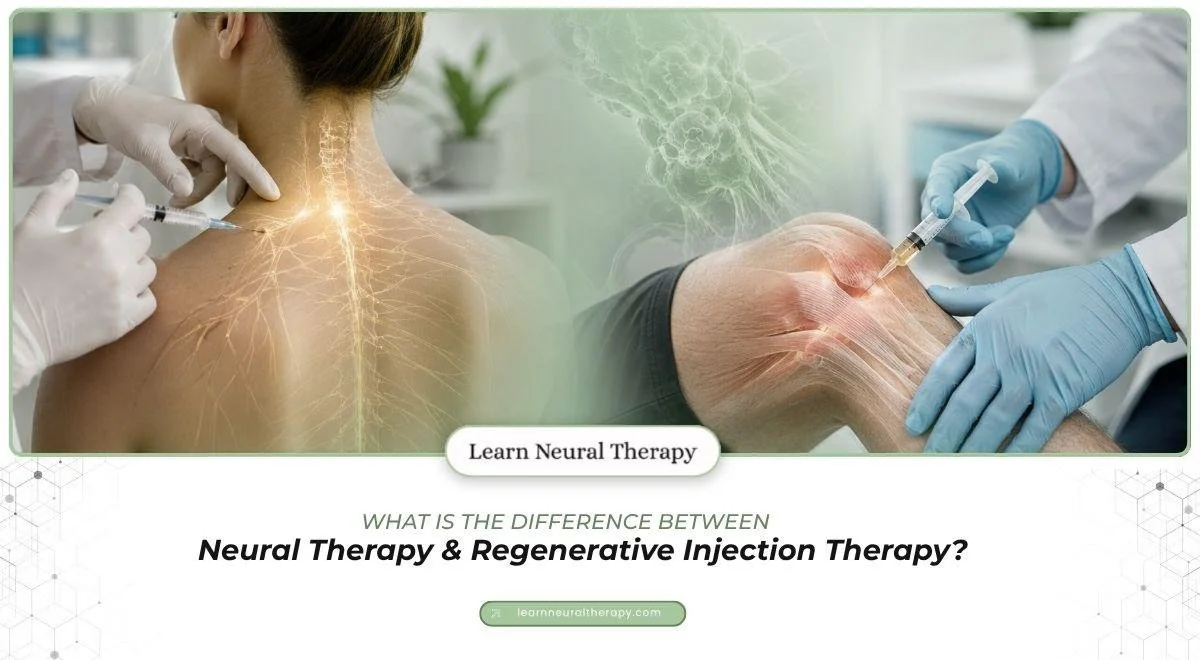
Pain has a strange way of showing up in the wrong place. A twisted ankle from years ago can turn into a nagging hip problem. An old scar can quietly mess with your posture. If you've ever asked a provider Why does this hurt here when the injury was over there? You already understand why so many patients and clinicians are turning to injection-based therapies for answers.
Two names come up again and again in this conversation: Neural Therapy and Regenerative Injection Therapy. They sound like they could be the same thing. They're not!
This guide breaks down what each therapy actually does, how they differ, and whether they can work side by side. Whether you're a patient trying to understand your treatment options or a provider exploring new tools for your practice, this comparison will clear up the confusion.
And if you want to go beyond reading and actually learn how to perform these techniques, Learn Neural Therapy offers hands-on and virtual training built for exactly that purpose.
What is Neural Therapy?
At its core, it's a treatment that focuses on the nervous system, not just the sore muscle or joint you can point to. The idea is simple: old injuries, surgical scars, and even dental work can leave behind disturbed patches of tissue called "interference fields." These fields can jam up the electrical signals traveling through your nerves, and that static can show up as pain somewhere completely different from the original injury. In an intervention study, mean VAS pain scores dropped from 7.94 before treatment to 4.63 after 2 weeks, 3.73 after 3 months, and 3.48 after 6 months.
How the Treatment Works
Neural therapy uses small injections of a local anesthetic, usually procaine, placed directly into these problem areas; scars, nerves, ganglia, or trigger points. The goal isn't to numb the pain temporarily. It's to reset the disrupted electrical signal so the nervous system can go back to functioning normally. Many patients describe a strange but welcome effect after treatment: tightness releases, old aches ease up, and mobility that had been stuck for years starts coming back.
The Role of Perineural Injection Therapy
This method is similar to perineural injection therapy. In this technique, small amounts of a solution are injected just beneath the skin around irritated peripheral nerves. This helps reduce swelling and chemical irritation that causes chronic pain.
Providers trained in these methods describe neural therapy as treating the "wiring" of the body rather than just the parts that are visibly damaged. A 2021 long-term study of 5% dextrose perineural injection in carpal tunnel syndrome reported favorable outcomes. That's a big shift from how most people think about pain treatment, and it's exactly why interest in this field keeps growing among both patients and clinicians.
What is Regenerative Injection Therapy (RIT)?
Regenerative Injection Therapy takes a different route. Instead of targeting nerve signals, it focuses on the actual structural tissue ligaments, tendons, and joints that have become weak, loose, or damaged over time.
Prolotherapy: The Most Common Form of RIT
The most well-known form of RIT is prolotherapy, where a solution ( a mild dextrose mixture) is injected directly into the injured ligament or tendon attachment. This injection triggers a small, controlled inflammatory response.
That might sound counterproductive, but it's actually the point. The body reads that mild inflammation as a signal to send healing cells to the area, kicking off a repair process that rebuilds collagen and tightens up loose connective tissue.
PRP & Other Biologic Options
Other forms use the patient's own biological material, like platelet-rich plasma (PRP) or, in some cases, stem cells, to boost that healing response further.
These are usually reserved for stubborn injuries or cases where standard treatments haven't worked.
What RIT is Best Used For?
RIT is commonly used for chronic joint instability, sports injuries, degenerative disc problems, and ligament laxity; situations where the tissue itself needs to be rebuilt, not just calmed down. Unlike neural therapy, which can bring noticeable changes within one or two sessions, regenerative injection therapy usually requires a series of treatments spaced weeks apart, since real tissue repair takes time.
Key Differences Between Neural Therapy & Regenerative Injection Therapy
It's easy to lump these two treatments together since they both involve needles and both aim to reduce pain. But once you look closer, the differences are pretty clear.
What Each Therapy Targets
Neural therapy focuses on the nervous system: scars, nerves, and interference fields that disrupt electrical signaling. Regenerative Injection Therapy targets structural tissue, i.e., ligaments, tendons, and joints that have become damaged or unstable.
How Each Therapy Works
Neural therapy uses a local anesthetic to interrupt and reset abnormal nerve signals. RIT works by triggering a controlled healing response and using substances like dextrose or PRP to stimulate tissue repair and regrowth.
Speed of Results
Patients receiving neural therapy or perineural injection notice a difference after just one or two sessions, since the treatment is resetting signals rather than rebuilding tissue. Regenerative injection therapy takes longer to show results because actual tissue regeneration is a gradual biological process.
Best-Suited Conditions
Neural therapy tends to help with chronic pain tied to old scars, nerve irritation, headaches, and pain that seems to "jump around" the body. RIT is generally chosen for ligament laxity, joint instability, sports injuries, and degenerative conditions where the tissue itself is compromised.
Injection Technique & Depth
Perineural injection therapy typically involves shallow injections just beneath the skin surface, around superficial nerves. RIT injections usually go deeper, reaching ligament and tendon attachment points on the bone.
Can They Be Used Together?
These therapies aren't rivals competing for the same job! In many clinical practices, they're used together as a combined strategy, because pain rarely comes from just one source.
Think about a patient with a chronic knee problem. The ligaments might genuinely be loose and in need of rebuilding; a job for regenerative injection therapy. But the surrounding nerves might also be irritated and sending confused pain signals, which is exactly where neural therapy and perineural injection techniques come in. Treating only the structural issue while ignoring the nervous system component (or vice versa) can leave a patient with incomplete relief.
Many providers who complete comprehensive training start by calming the nervous system with neural therapy, then follow up with regenerative injection therapy once the nerve interference has settled down. This layered approach produces more lasting results than relying on a single technique alone, especially for complex or long-standing pain conditions.
Which Therapy is Right for You?
There's no one-size-fits-all answer here, and honestly, that's a good thing; it means treatment can actually be matched to what's really going on in your body.
If your pain seems tied to an old injury, surgical scar, or nerve irritation, and especially if it seems to move around or doesn't match up with any obvious structural damage, neural therapy or perineural injection therapy might be the better starting point.
If your pain comes from a joint that feels loose, unstable, or keeps re-injuring itself despite rest and physical therapy, regenerative injection therapy may be more appropriate.
The best way to know for sure is to talk with a provider who's trained in both approaches and can assess your specific situation. That's a big part of why proper training matters so much in this field, as a well-trained clinician doesn't just pick one technique and apply it to everyone. They evaluate the nerve and structural components separately, then build a treatment plan that actually fits.
In a Nutshell,
Neural therapy and regenerative injection therapy both aim for the same outcome: real, lasting pain relief instead of a quick, temporary fix, but they get there in completely different ways. One resets the body's electrical wiring. The other rebuilds the structural tissue that wiring runs through. Understanding that difference matters, whether you're a patient deciding on treatment or a provider deciding what to add to your practice.
If you're a healthcare provider looking to bring these techniques into your own clinic, Learn Neural Therapy offers in-person and virtual training designed to build real, confident skills- not just theory. The courses cover everything from foundational injection techniques to advanced applications, built by clinicians, for clinicians, with real-world protocols you can start using right away.
Ready to expand what you can show your patients? Visit Learn Neural Therapy today to view upcoming classes and take the next step in your training.
FAQ
What is neural therapy used for?
Neural therapy is mainly used to treat chronic pain linked to old scars, nerve irritation, and interference fields that disrupt normal nerve signaling. It's used for headaches, whiplash, and pain that doesn't respond to standard treatment.
Is perineural injection therapy painful?
Most patients describe perineural injection as a mild pinch or pressure, since the injections are shallow and use small needles. Discomfort is generally brief and much milder than the chronic pain it's treatingNeural Therapy.
How many sessions does regenerative injection therapy require?
Since RIT relies on the body's natural healing process, most patients need a series of sessions spaced several weeks apart, rather than a single treatment.
Can neural therapy and regenerative injection therapy be combined?
Yes. Many providers use both approaches together, addressing nerve interference and structural tissue damage as part of one coordinated treatment plan.