
Understanding Chronic Pain Causes, Symptoms & the Role of Neural Therapy

You've tried the medication. You've done the physical therapy. Maybe you've had a few cortisone shots. And yet, the pain is still there. Sometimes in the same spot, sometimes somewhere new, sometimes worse than before.
You're not alone if that sounds familiar. And more importantly, you're not imagining it.
Chronic pain rarely comes from one simple cause. A global study across 52 countries found pooled chronic pain prevalence around 53%, underscoring how widespread the problem is.
For many people, it's rooted deep in the nervous system, which is exactly why standard treatments only get them so far. At Learn Neural Therapy, we've spent years helping healthcare providers understand a fundamentally different approach: one that targets the source of the pain.
This guide will walk you through what chronic pain actually is, what's driving it in your body, and how neural therapy treatment provides a path toward real, lasting relief.
What is Chronic Pain & Why Is It So Hard to Treat?
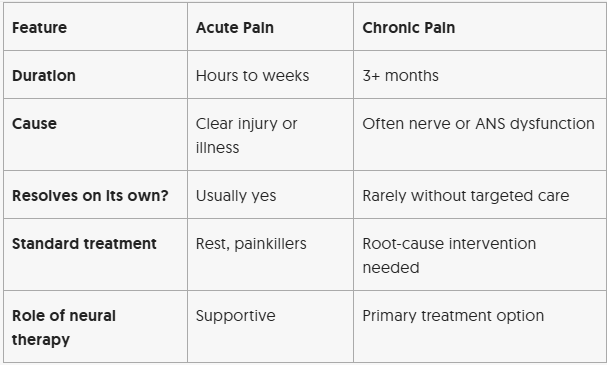
Acute pain is your body's built-in alarm. You sprain your ankle, it hurts, it heals, the alarm turns off. Chronic pain is what happens when that alarm gets stuck in the "on" position for three months or more; sometimes long after the original injury has completely healed.
Standard medicine handles this by lowering the volume on the alarm. Painkillers, anti-inflammatories, and cortisone injections reduce what you feel. But they don't ask why the alarm is still going off. That's why so many people feel relief for a few weeks and then end up right back where they started.
The Most Common Causes of Chronic Pain
Chronic pain rarely traces back to a single event. The most common contributors include:
Nerve damage from past injuries or surgeries that didn't fully heal.
Scar tissue disrupts normal nerve communication.
Long-term inflammation that became permanent instead of temporary.
Autonomic nervous system (ANS) dysfunction, when the system controlling your involuntary body functions starts misfiring.
Ganglion overactivity nerve clusters send faulty signals throughout the body.
One thing patients find surprising: a scar from a surgery years ago can generate pain in a completely different part of the body. That's not a quirk. It's how the nervous system works.
Recognizing the Symptoms of Chronic Pain
Chronic pain doesn't always look obvious. Sure, there's the persistent burning, aching, or shooting pain. But it can also show up as:
Fatigue that no amount of sleep fixes.
Brain fog and trouble focusing.
Digestive problems like bloating or irregular bowels.
Poor sleep quality.
Low mood, anxiety, or depression that feels disconnected from daily life.
When several of these symptoms appear together, the nervous system is almost always part of the picture.
Key Differences Between Chronic Pain & Acute Pain
How the Nervous System Drives Chronic Pain?
Your autonomic nervous system works quietly in the background. It manages your heart rate, digestion, blood pressure, immune response, and pain signals. Most of the time, you don't notice it. But when it's thrown off, you notice everything.
Here's what happens at the cellular level. A healthy nerve cell holds a stable electrical charge around -70 millivolts (mV). This charge keeps the nerve ready to respond normally when called upon. When nerve cells are damaged by trauma, surgery, or ongoing inflammation, that charge drops to around -47 to -50 mV. At that lower charge, the nerve starts firing abnormal signals on its own continuously even when there's no real threat to respond to.
Because every nerve connects to the wider nervous system, those rogue signals don't stay local. They travel, causing pain or dysfunction in areas nowhere near the original injury.
Understanding Interference Fields
An interference field is any area in the body where damaged tissue is sending abnormal signals into the nervous system. Surgical scars are among the most common, such as a knee surgery from ten years ago, a C-section scar, or a tooth extraction site; any of these can become active interference fields driving symptoms far from their location.
This is why treating only the painful area fails. You may be looking in the wrong place entirely.
What is Neural Therapy Treatment?
Neural therapy treatment is a medical approach that uses small, precisely placed injections of local anesthetic, most commonly procaine (related to novocaine), to reset dysfunctional nerve cells and interference fields. Developed by German physicians in the early 20th century, it has been used widely in Europe for decades and is now growing in North America.
Injections target specific areas: scars, nerve pathways, ganglia, or any tissue that has become an interference field. The goal is to restore the normal electrical charge in those nerve cells so the nervous system stops misfiring and the body can start healing itself.
How Neural Therapy Targets the Root Cause?

A cortisone shot reduces inflammation in one spot for a few weeks. Neural therapy treatment does something different; it corrects the nerve cell dysfunction behind the pain. When procaine reaches a damaged nerve or interference field, it raises the resting membrane back toward normal, stabilizes the cell membrane, and lengthens the gap between nerve firings.
The anesthetic leaves the body quickly. But the positive change in nerve function can last far longer. That's the real mechanism: a brief chemical intervention that triggers a durable functional shift.
Perineural Injection Therapy: Targeting Superficial Nerve Pain
Perineural injection therapy is a specific technique within neural therapy that focuses on small, surface-level nerves just under the skin, called cutaneous nerves. Instead of focusing on deeper body structures, perineural injection delivers small amounts of a diluted solution right next to the nerves. This helps reduce inflammation caused by the nerves themselves.
Many patients feel relief almost immediately in the treated area. That's how responsive these surface nerves are when addressed directly.
Conditions That Respond Well to Perineural Injection Therapy
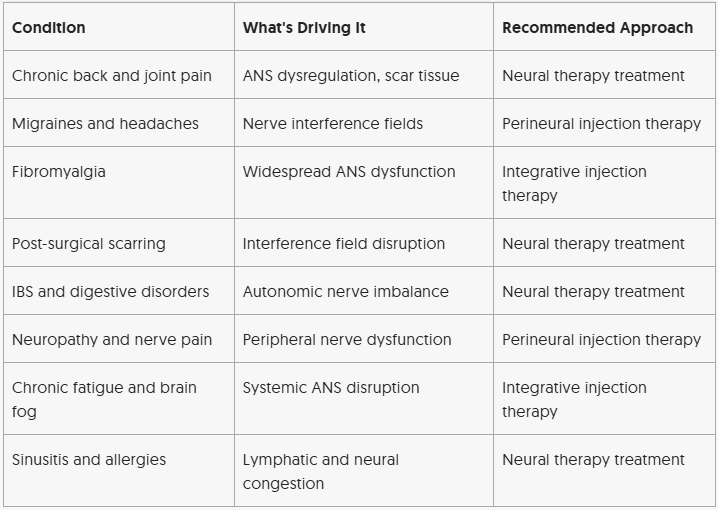
Perineural injection therapy has shown strong results for:
Chronic headaches and migraines.
Neck, shoulder, and upper back pain.
Post-surgical soreness and scar sensitivity.
Neuropathy and nerve-related pain.
Hip, knee, and joint pain.
Pelvic pain syndromes.
If you've had pain that resists every other treatment, superficial nerve involvement may be why.
Conditions Treated by Neural Therapy & Perineural Injection Therapy
What to Expect During a Neural Therapy Treatment Session?
Your first neural therapy session may feel different from any medical appointment you've had. Here's a general picture of how it goes:
A thorough history: Your provider will ask about past surgeries, injuries, dental procedures, and illnesses that might be creating interference fields.
Mapping treatment targets: Based on your exam and history, specific sites for injection are identified.
The injections: Fine needles deliver small amounts of procaine into targeted areas. Most patients describe the discomfort as minimal to none.
Tracking your response: How your body reacts after the first few sessions guides the ongoing plan.
Sessions usually run 30–60 minutes. Most patients notice meaningful improvement within 3–6 sessions, though long-standing conditions may take more time.
Is Neural Therapy Treatment Safe?
Yes, neural therapy is safe. When performed by trained neural therapy practitioners, this treatment carries a strong safety record. Procaine is one of the most well-tolerated local anesthetics available. Side effects are rare and typically mild — brief soreness or slight lightheadedness being the most common. The most important factor is ensuring your provider has proper training in both neural therapy injection technique and anatomy.
How to Find Qualified Neural Therapy Practitioners?
Every provider does not have specific training in neural therapy treatment. Ask directly about their background and where they trained.
Neural therapy practitioners come from many fields; naturopathic doctors, medical doctors, osteopathic physicians, nurse practitioners, chiropractors, acupuncturists, and dentists can all incorporate these techniques if they hold a proper injection scope and have completed formal training. Learn Neural Therapy maintains a Find a Provider directory to help patients connect with trained clinicians nearby.
The Pain is Real: The Cause Might Just Be Somewhere Else
Chronic pain is not simply about the spot where it hurts. It travels through your nervous system and causes symptoms that appear unrelated. These symptoms can show up in parts of your body that are far from the original injury. You may also feel fatigue, mental fog, and frustration that no standard medication can help.
Neural therapy treatment, when paired with perineural injection therapy and an integrative care plan, produces outcomes that patients with long-term pain have stopped believing were possible.
If you're a patient ready to find a trained provider, or a healthcare professional looking to add these powerful tools to your practice, Learn Neural Therapy is your starting point. Visit learnneuraltherapy.com to explore the Find a Provider directory or browse upcoming training programs. The answer to your chronic pain or the skills to treat it may be one step away.
FAQs
How is neural therapy treatment different from a cortisone injection?
Cortisone quiets local inflammation for a limited time. Neural therapy treatment addresses the nerve cell dysfunction behind the pain, which is why results tend to be more durable.
How many perineural injection therapy sessions will I need?
Most patients see noticeable shifts within 3–6 sessions of perineural injection therapy. Your provider will adjust the plan based on how your body responds.
Does neural therapy treatment hurt?
Very fine needles and small volumes keep discomfort low. Most patients are surprised by how comfortable the sessions are. Experienced neural therapy practitioners know how to keep the process smooth.
Can integrative injection therapy work alongside my current care?
Yes. Integrative injection therapy is built to complement other treatments. Keep all of your providers informed about what you're receiving so care stays coordinated.
Who is qualified to perform neural therapy treatment?
Any licensed provider with an injection scope of practice who has completed formal training in neural therapy is equipped to provide this care.
What's the difference between neural therapy and perineural injection therapy?
Neural therapy treatment is the full framework, targeting scars, ganglia, nerves, and deep interference fields throughout the body. Perineural injection therapy is a focused technique within that framework, working specifically on superficial cutaneous nerves.