
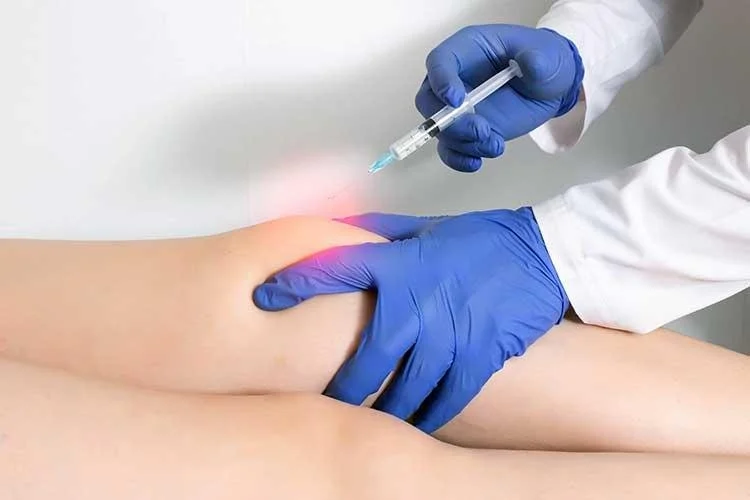
You have tried everything. Rest, painkillers and physical therapy. You may even have had scans, and everything looks fine. Yet the pain remains. Aches, burning, stabbing sensations that are hard to explain and even harder to live with.
If that sounds familiar, you are not overreacting.
Nerve pain is one of the most misunderstood conditions in modern medicine. It doesn't always appear on imaging. It doesn't always respond to conventional treatments. And it can persist long after the original injury has healed — because the real problem isn't the tissue. It's the nervous system itself.
This is where perineural injections come in. This treatment directly targets inflamed nerves and resets the way they fire, addressing chronic pain at its source.
Let's look at what actually causes painful nerves — and how perineural injections offer a real path to relief.
What Actually Causes Nerve Pain?
Most people think of pain as a signal, i.e., something hurts, the nerve reports it, and the brain registers it. Simple enough. But chronic nerve pain is not quite that logical.
Nerves function by maintaining a particular electrical charge across the membrane. The resting charge of a healthy nerve is about a -70 millivolt range. It remains stable and only goes off when there is a legitimate reason to go, and when the danger has passed, it remains quiet.
If the nerve is damaged due to trauma, surgery, chronic inflammation, or even scar tissue, the charge diminishes. It could drop to 47 or 50 millivolts. This causes the nerve to become hyperactive at that level. It continues to fire all the time, even if there is nothing wrong. The brain still hears the alarm after the fire has been extinguished.
This is exactly the pattern that perineural injections are designed to address — by calming the overactive nerve directly at the source and restoring its natural resting charge.
This is why many chronic pain sufferers feel that they are not being taken seriously. They appear to be fine on their scans.
Common Reasons Nerves Go Wrong
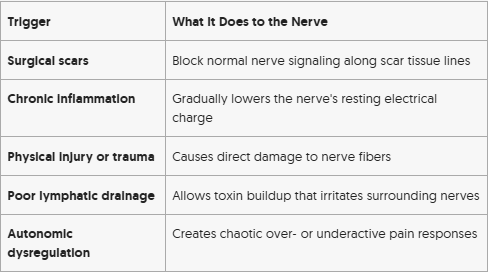
What makes this worse is that all nerves are connected. An abnormal signal from a scar on your abdomen can travel along nerve pathways and show up as shoulder pain, headaches, or fatigue. The source and the symptom are nowhere near each other, which is why finding the root cause matters so much.
Why Standard Treatments Often Miss the Mark?
Painkillers reduce how much pain you feel. Anti-inflammatories reduce inflammation of the tissue. None of these therapies hit the nerve dysfunction itself. They control the output but do not change the input. This is why so many people experience temporary relief but then return to pain months or years later.
Treating the nerve itself is what makes the difference, not just the area around it.
What are Perineural Injections?
Perineural injections are small, shallow injections of diluted local anesthetic, most commonly procaine, delivered along inflamed nerve pathways just under the skin. These are gentle and minimally invasive procedures, unlike deep cortisone injections or nerve blocks.
“Perineural” is just the word for “around the nerve.” The aim is to immerse the nerve in a solution that will return its electrical environment to a healthy range.
At the cell level, procaine stabilizes the nerve cell membrane. It brings the resting membrane potential back to its healthy -70 millivolts. Once the nerve is out of this overactive state, it no longer sends out signals of pain continuously. The brain no longer receives fake alarms, and the pain subsides.
Even though the effects of procaine are gone from your body within hours, it can last for much longer. The aim is not to deaden the nerve, but to heal it. After this, the nerves can be stabilized, and the body's healing mechanisms can take over.
How They Fix the Nerve — Step by Step
Procaine stabilizes the nerve membrane.
At the cellular level, procaine works directly on the nerve cell membrane. It restores the resting membrane potential back toward the healthy −70 millivolt range.
The nerve stops firing abnormally.
Once the charge stabilizes, the nerve is no longer in a hyperactive state. It stops sending continuous, unwarranted pain signals to the brain.
The brain stops receiving false alarms.
With the nerve calm, the brain no longer perceives pain from that pathway. The sensation of chronic pain subsides — sometimes immediately, sometimes gradually over the following days.
The body's healing takes over
Procaine clears from the body within hours, but the benefit lasts because the goal was never to numb the nerve — it was to reset it. Once the nerve is stable, the body's own repair processes can maintain and build on that improvement.
How Perineural Injections Help Heal These Common Conditions?
Because the nervous system touches every part of the body, perineural injections — a core technique in neural therapy can reach problems that standard treatments miss entirely.
Silencing the Pain Loop in Joint & Muscle Problems
In chronic joint pain, arthritis, and tendon issues, the nerve doesn't switch off after the injury heals; it keeps firing. Perineural injections calm that overactive signaling directly at the nerve, breaking the loop and allowing the tissue around it to finally recover.
Resetting Overactive Nerves Behind Headaches & Facial Pain
Persistent headaches trace back to sensitized nerves along the scalp, face, and neck, not the head itself. Perineural injections target those specific nerve pathways, lowering their activity and giving the nervous system a chance to stop triggering pain unprompted.
Reducing Pressure & Restoring Flow in Nerve Entrapment and Neuropathy
In conditions like carpal tunnel, sciatica, and peripheral neuropathy, compressed or damaged nerves stay inflamed and hypersensitive. Perineural injections reduce local inflammation, ease the pressure on the nerve, and create the right environment for gradual nerve recovery.
Deactivating Scars as Hidden Pain Drivers
Old scars are one of the most overlooked sources of ongoing nerve pain. Even a small surgical scar can act as an interference field, disrupting nerve signals in areas far from the scar itself. Perineural injections deactivate that disruption at the source, restoring normal signaling along affected nerve pathways.
What a Perineural Injection Session Actually Looks Like
If you've never had this type of treatment, it's natural to wonder what to expect. The short answer: it's much less intimidating than it sounds.
Assessment — Your provider identifies areas of nerve tenderness, maps any scar tissue, and listens carefully to your pain patterns. The injection site is chosen based on nerve anatomy, not just where it hurts.
Preparation — A diluted procaine solution is prepared. The skin is cleaned at the target sites.
Injection — A very fine needle delivers small amounts of solution just under the skin along nerve pathways. Most patients describe it as a mild sting at most.
Response — Some people feel relief almost immediately. Others notice gradual improvement over the following days as the nervous system recalibrates.
Follow-up — Most patients require 4 to 6 treatments spaced 7 to 10 days to 2 to 4 weeks apart, depending on their condition. Between sessions, the nervous system continues to stabilize and heal — and results last longer with each treatment.
The procedure is brief, well-tolerated, and carries a very low risk profile when performed by a properly trained provider.
Chronic Nerve Pain Has a Root Cause & a Real Fix
Nerve pain isn't a life sentence. It isn't something you just have to manage forever with medications that barely take the edge off.
When you find that a nerve isn't working properly and there's a gentle way to fix it, the solution becomes clearer.
PIT injection training provides a focused and proven way to treat nerve problems directly at their source. This approach is part of a larger method called neural therapy.
The training is available, the science is solid, and the outcomes speak for themselves for healthcare providers to bring this kind of care to their patients. Learn Neural Therapy offers structured courses and neural therapy workshops that guide you every step of the way.
Explore Classes at Learn Neural Therapy while your patients wait for someone who can actually help them. This is how you become that provider!
FAQs
What is a perineural injection?
A perineural injection is a small injection of diluted procaine delivered around inflamed nerves just under the skin. It resets abnormal nerve signaling, reduces chronic pain, and supports the body's natural healing process without deep tissue involvement.
Are perineural injections painful?
Most patients find them very tolerable. The needles used are fine-gauge, and the procaine itself begins numbing on contact. Discomfort is typically minimal and brief.
Is perineural injection safe?
Yes. Perineural injections are considered safe when performed by a trained provider. Side effects are rare, and the injection depth significantly lowers any risk compared to deeper procedures.
How long do perineural injections last?
Most patients will require 4-6 Perineural Injection Therapy treatments spaced anywhere from 7-10 days to 2-4 weeks apart, depending on their condition. No pain meds or local anesthetics are required. After the first Perineural Injection Therapy treatment, the pain relief only lasts a few hours, and the pain returns.