
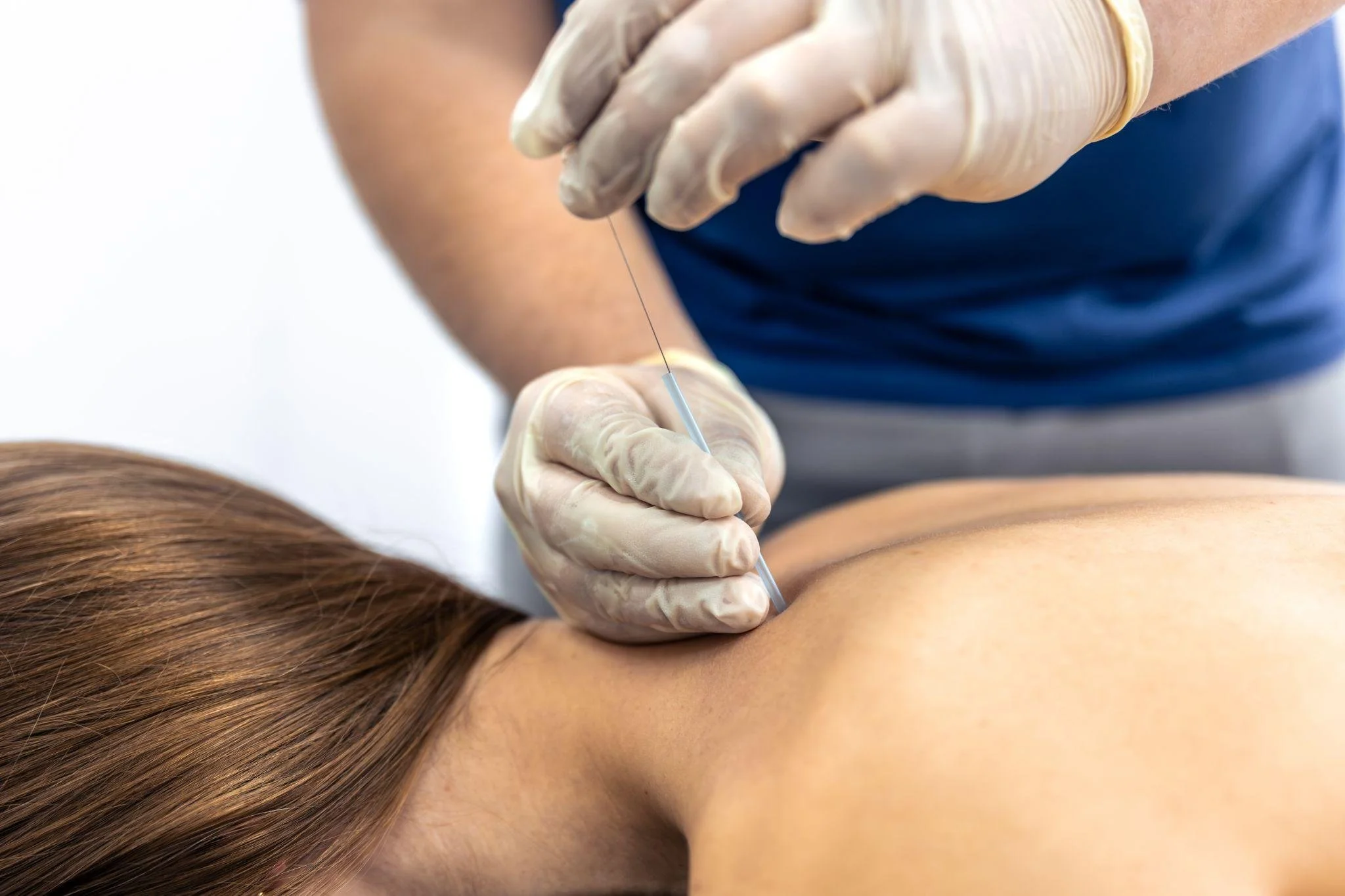
Think of a pain that just won’t leave. Maybe it’s a shoulder that has been stiff since an old injury, or an ache that showed up after surgery and never faded. You’ve tried pills, stretching, and rest. Then a friend asks, “Have you heard of a neural therapy injection?”
It sounds strange at first. But the idea is simple. A small shot of numbing medicine, placed in the right spot, may calm nerves that keep sending pain signals. At Learn Neural Therapy, we train healthcare providers to use this technique, and patients write to us with questions. So this guide answers them in simple words. You’ll see what it is, how a visit goes, and what to expect, including what science has and hasn’t proven yet.
What is a Neural Therapy Injection?
A neural therapy injection is a small shot of local anesthetic, most usually procaine, placed in a scar, nerve, nerve cluster, or sore spot. The goal is to calm nerve signals that have gone off track so the body can ease pain and heal.
The idea is old. In the 1920s, a German doctor named Ferdinand Huneke gave his nurse procaine for rheumatism, and her long-standing migraines stopped. He and his brother Walter spent years studying why. Today, neural therapy is common in parts of Europe and Latin America, and it’s growing in the United States.
What Is in the Syringe?
Mostly procaine. It was the first local anesthetic ever made, and it’s close to the numbing medicine your dentist uses. The difference is that a neural therapist leaves out epinephrine and preservatives. Procaine also breaks down fast, in about 15 to 20 minutes. Some providers add vitamins or other injectables, depending on the patient.
Neural Therapy Injection vs. Perineural Injection Therapy
These two get mixed up a lot. Both target irritated nerves, but they use different liquids and have different roots.
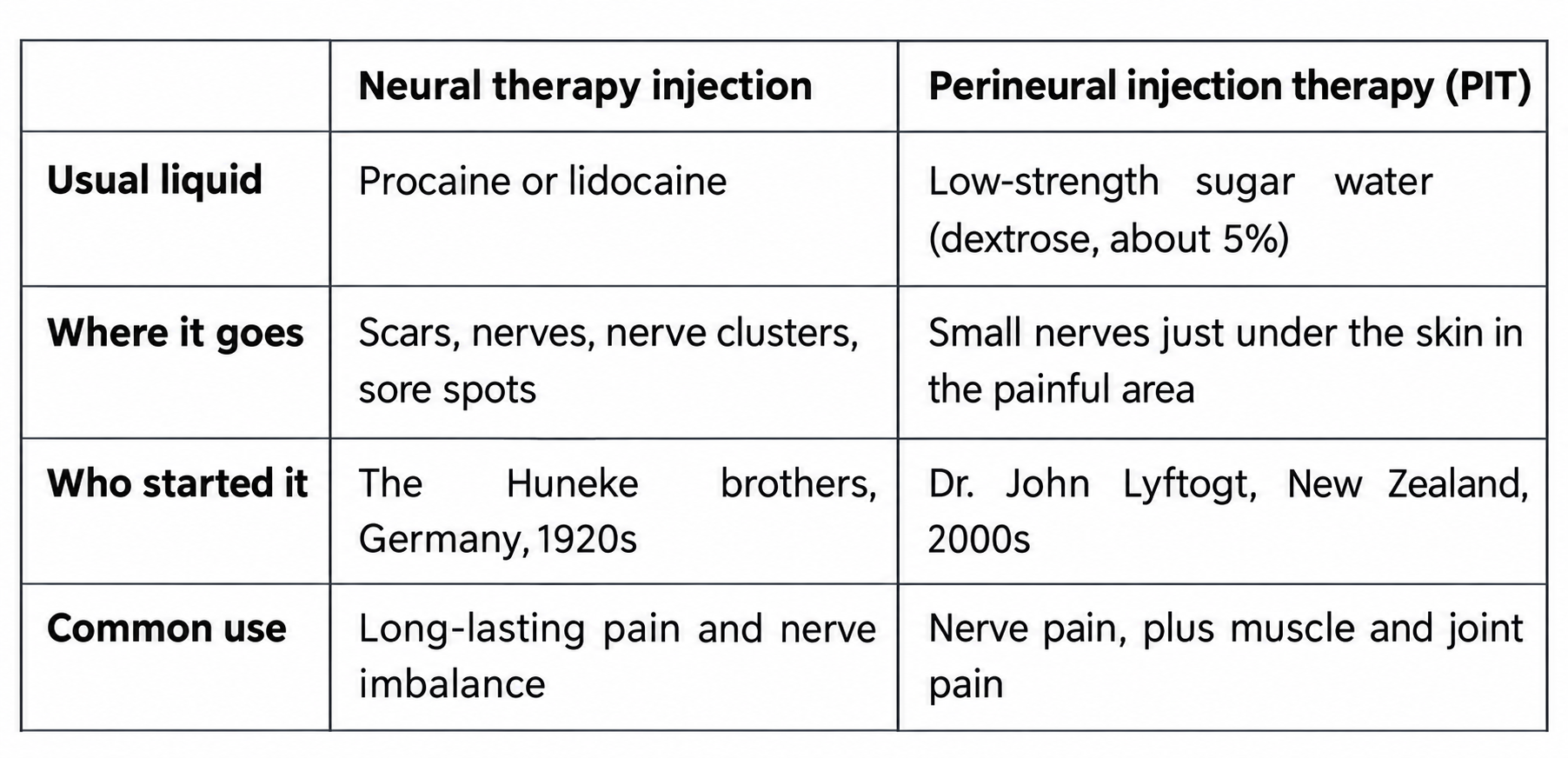
Many trained providers learn both. If you’re booking a visit, ask which one the clinic uses and why.
How Does Neural Therapy Treatment Work?
Researchers are still studying the exact reasons, so here’s the leading theory.
Nerves Hold an Electric Charge
Think of each nerve cell as a tiny battery. After surgery or injury, that charge can slip. The nerve may then keep firing pain messages even after the tissue heals. Procaine is thought to steady the cell and nudge the charge back to normal. That’s the core idea behind neural therapy treatment.
Why a Scar Can Matter
Scar tissue can tug on nearby nerves. And since nerves are all linked, some practitioners believe a trouble spot in one place can cause symptoms somewhere else. An old surgery scar, for example, might play a part in back pain. It’s a theory, not a proven rule. It’s also why your provider will ask about past surgeries and injuries.
Benefits of Neural Therapy Injections
People look into this option for a few reasons.
What People Use It For
Most patients come for long-lasting joint, muscle, or nerve pain. Others come for scar pain or headaches. Some report changes in digestion or energy too, though the research on those is much thinner.
A Low-Drug, Non-Surgical Option
Each visit is outpatient. There’s no hospital stay and no long recovery, so most people go home the same day. Some patients find enough relief to cut back on pain pills, though results vary.
What the Research Shows
Here is where the science stands today:
Pain relief: In a trial of 72 adults with fibromyalgia, those who got injections plus exercise had lower pain and depression scores at six weeks than those who only exercised.
Staying power: In a hand-tendon study, the injection group did better at one month, but scores were about equal at 12 months. Relief may fade for some people.
Fewer pills: Providers frequently report that patients need less pain medicine. Large trials haven’t proven this yet.
Pinched nerves: Perineural injection therapy has its own research. A review of studies on 5% dextrose found good results for problems like carpal tunnel syndrome. Even so, experts say more high-quality trials are needed.
Perineural injections look promising, but they aren’t a guaranteed fix.
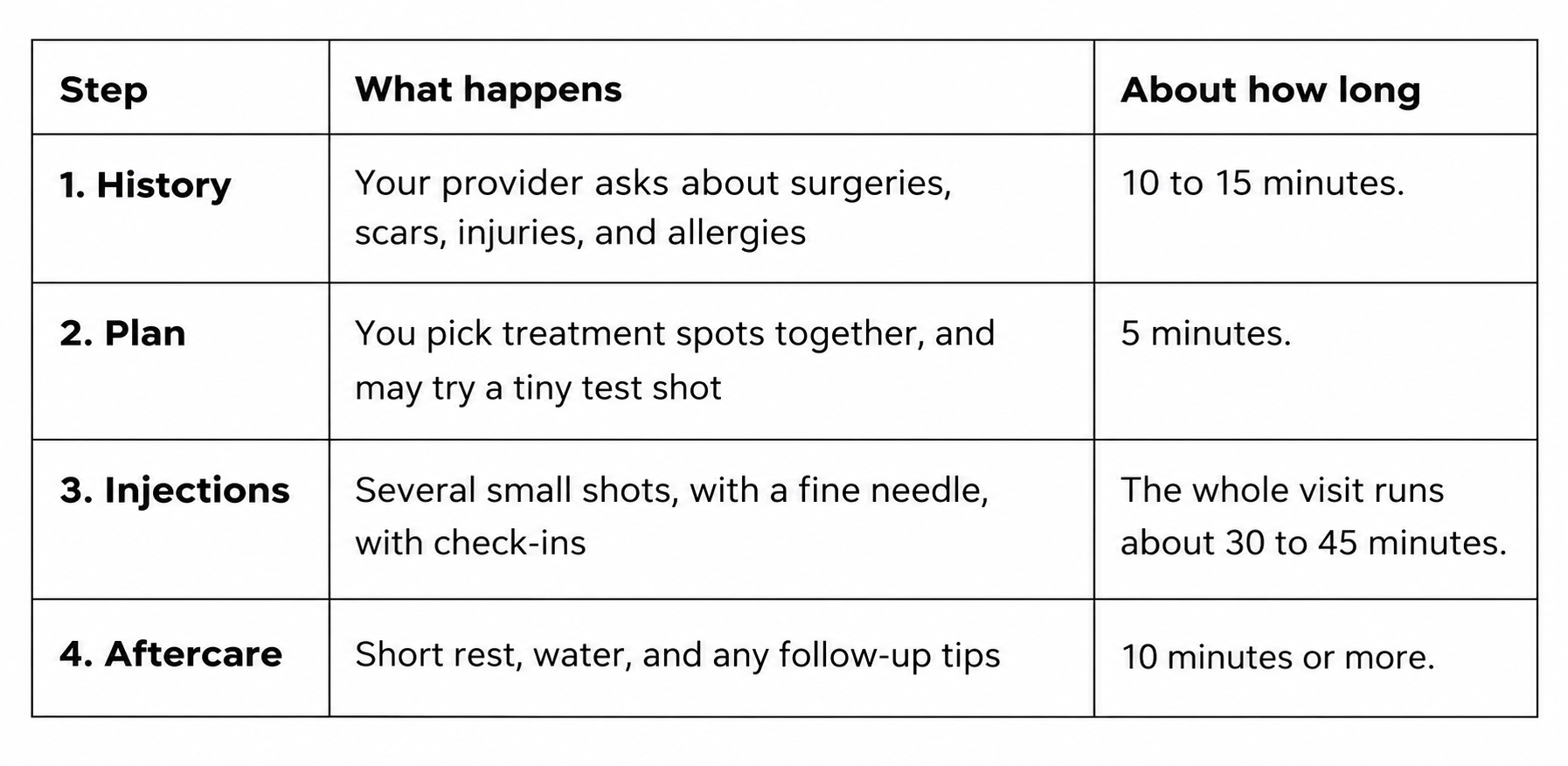
The Neural Therapy Injection Process, Step by Step
A first visit is calmer than most people expect. Here’s the usual flow.
Before Your Appointment
Tell your provider about any allergies, especially to numbing drugs like lidocaine or procaine. Wear loose clothing. If the area is hard to reach, you’ll get a gown or drape.
During the Session
Your provider uses a very fine needle to give several small shots, just under the skin. They explain each step as they go. Some do a tiny test injection first, which helps if you’re nervous.
Right After
You may feel a bit lightheaded for up to 10 minutes. Your provider will keep an eye on you until it passes. You might be told to rest and drink extra water.
What to Expect: Feeling, Side Effects, and Results
Does It Hurt?
Most people compare it to a mosquito bite. Sensitive spots and thick scars can sting more, but the numbing effect starts right away.
Common Side Effects
Small bruises and brief dizziness are the most common. Some people feel worse for a day before they feel better. Providers call this a Herxheimer-type response. Others feel emotional as old tension lets go. One small study of 22 patients found that side effects, like injection pain and emotional stress, lasted minutes to hours, and two days at most. Tell your provider about anything that worries you.
How Many Sessions Will You Need?
It depends on how long the problem has been there. Many patients need three to six treatments. One clinic that uses perineural injections reports about four to six visits, spaced roughly a week to a month apart. It also says the first round of relief may last only hours. So don’t panic if the pain comes back. Progress usually arrives in steps!
Is It Safe, Proven & Covered?
Who Should Skip It
Anyone allergic to procaine, lidocaine, or similar drugs. Any needle carries a small risk of infection, and an injection near the chest can, rarely, puncture a lung. That’s why a provider’s training matters so much.
What the Research Says
The honest answer is “promising, but limited.” Small studies, like the two in the table above, show real benefits for some people. But many are small, and several insurers still call neural therapy investigational. We need more large, well-designed trials.
FDA & Insurance
Procaine is FDA-approved as an anesthetic, but not specifically for neural therapy, so this care is treated as experimental in the U.S. Most insurance plans don’t cover it. Ask the clinic about fees before you book.
How to Find a Qualified Provider?
Training and screening matter more than anything else. Before you book, ask:
What training do you have in injection techniques?
Do you screen for allergies to numbing drugs?
What’s the plan if I don’t improve after a few visits?
Learn Neural Therapy also keeps a “Find a Provider” list on our website for patients searching in several states.
Ready to Take the Next Step?
A neural therapy injection won’t suit everyone, and it isn’t a magic fix. But for long-lasting, nerve-related pain, it’s a gentle option worth talking about with a trained provider. If you’re a patient, use our Find a Provider page to start your search.
If you’re a doctor, nurse practitioner, chiropractor, or acupuncturist, you can offer neural therapy treatment and perineural injection therapy in your own practice. Explore the hands-on and online classes at Learn Neural Therapy today, and learn the skills your patients are asking for.
FAQs
Is a neural therapy injection the same as the Novocaine at the dentist?
Almost. Both use procaine. Neural therapy leaves out epinephrine and preservatives and places the shot in different spots.
How long does relief last?
It varies. Some people feel better right away. Others build up results over several visits.
Is neural therapy the same as PIT?
No. Neural therapy usually uses procaine or lidocaine, while PIT usually uses low-strength dextrose. They’re related but not identical.
Will insurance cover neural therapy treatment?
Usually not. Plans call it experimental, so ask about cost first.
Can I drive afterward?
Lightheadedness usually fades within 10 minutes, and many people leave feeling fine. Wait until you feel steady, and follow your provider’s advice.