
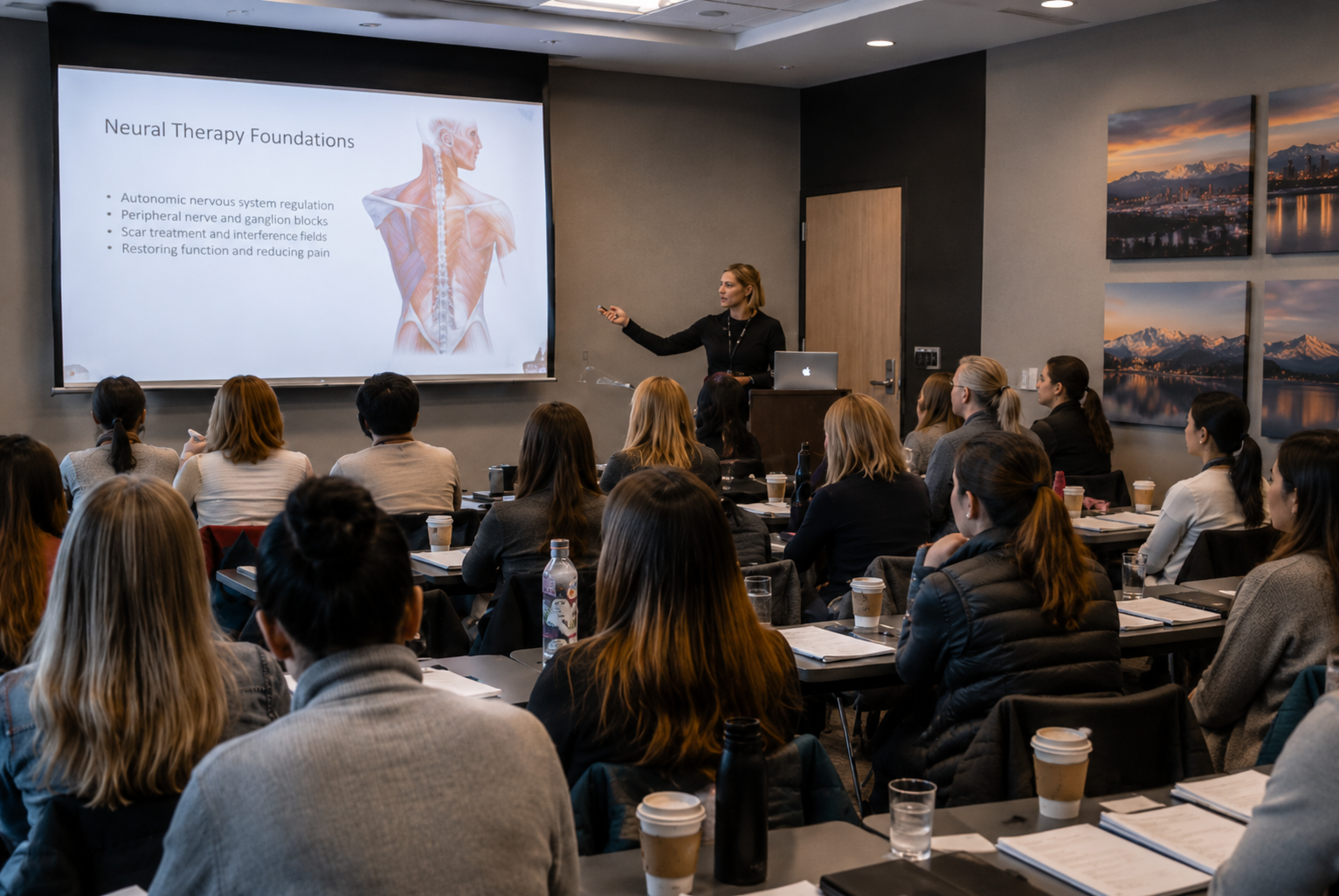
If you’re a healthcare provider looking to expand your clinical toolkit, better understand the nervous system, and offer patients another option beyond symptom management, neural therapy is one of the most fascinating and clinically useful modalities to learn.
Over the past several years, interest in neural therapy and perineural injection therapy has grown tremendously among integrative and functional medicine providers. Many clinicians are seeing patients with chronic pain, dysregulation, inflammation, GI dysfunction, post-viral syndromes, stress-related illness, and complex chronic conditions that don’t fit neatly into a single box.
Neural therapy gives practitioners another lens through which to understand the body — one centered around the autonomic nervous system, tissue signaling, scars, fascia, and neurologic regulation.
If you’ve been curious about learning neural therapy, here are five reasons why attending a hands-on workshop may completely change the way you practice medicine.
What Is Neural Therapy?
At its core, neural therapy is an injection-based treatment approach that utilizes local anesthetics - most commonly procaine - to help restore normal signaling within the autonomic nervous system.
The goal is not simply to “numb” tissue. Instead, the neural therapy workshop aims to interrupt dysfunctional neurologic signaling patterns that may be contributing to chronic pain, inflammation, dysregulation, or impaired healing.
Clinically, practitioners often inject scars, peripheral nerves, autonomic ganglia, trigger points, and areas of tissue irritation or dysfunction.
One of the reasons so many integrative practitioners become passionate about this work is because the effects can extend far beyond pain management alone.
Conditions Commonly Addressed in Clinical Practice
Providers use neural therapy and perineural injection therapy in a wide variety of chronic and complex conditions, including:
Chronic musculoskeletal pain
Migraines and headaches
Neuralgia and neuropathic pain
IBS, GERD, SIBO, and digestive dysfunction
Pelvic pain and menstrual concerns
Chronic sinus issues
Stress-related nervous system dysregulation
Scar interference fields
Joint pain and inflammatory conditions
Fatigue and post-viral syndromes
While no modality is a cure-all, many clinicians find that neural therapy becomes an important piece of a larger integrative treatment strategy.
1. Hands-On Training Changes Everything
Reading about injection therapy and actually learning how to safely perform it are two very different experiences.
One of the biggest benefits of attending an in-person workshop is the opportunity to learn anatomy, injection technique, safety, and clinical reasoning in a supervised environment.
Our workshops are designed to be extremely practical and clinically focused. The goal is not just to teach theory - it’s to help practitioners leave feeling confident enough to thoughtfully begin integrating these techniques into practice.
Throughout the training, providers learn:
Foundations and philosophy of neural therapy
Autonomic nervous system anatomy
Injection safety and technique
Scar treatment approaches
Perineural injection therapy
Clinical applications for pain, GI conditions, migraines, and more
Documentation, consent, and practical implementation
The workshops are highly interactive, and participants spend significant time practicing techniques under supervision.
For many attendees, this becomes one of the most immediately applicable continuing education experiences they’ve had.
2. Patients Are Looking for More Options
Patients today are increasingly seeking therapies that go beyond simply suppressing symptoms.
Many people are looking for approaches that address regulation, nervous system balance, chronic inflammation, tissue healing, and the body’s overall adaptive capacity.
Neural therapy and perineural injection therapy fit naturally into that conversation.
As clinicians, we’re seeing growing interest in:
Non-opioid pain approaches
Regenerative and restorative therapies
Nervous system-focused medicine
Fascia and scar work
Integrative treatment models
Adding these tools can meaningfully expand the types of patients you’re able to help - especially complex chronic cases where conventional approaches alone may not fully resolve the issue.
3. Learn From Clinicians Who Use This Every Day
One thing we always tell providers is this: techniques are only as valuable as the clinical reasoning behind them.
Our trainings are taught by practicing clinicians who actively utilize neural therapy in real-world patient care every single week.
Dr. Anne Hill and Dr. Ilana Gurevich come from slightly different clinical backgrounds, which creates a really rich learning environment. Between gastroenterology-focused practice, pain management, acupuncture, nervous system regulation, and injection medicine, we bring a wide range of clinical perspectives into the classroom.
More importantly, we try to create an environment where people feel comfortable asking questions, practicing, and learning.
This isn’t a lecture where you sit quietly in the back of the room for two days. It’s collaborative, hands-on, and deeply clinically oriented.
4. Earn CEUs While Building Real Clinical Skills

Continuing education is important — but ideally it should actually improve your practice.
Our workshops are approved for:
NANCEAC CEUs for naturopathic physicians
NCCAOM PDA points for acupuncturists
The trainings are designed for licensed providers with injection scope, including:
NDs/NMDs
MDs and DOs
Nurse practitioners
Chiropractors
Acupuncturists
Dentists and other injection-trained providers
Whether you’re completely new to injection therapy or already comfortable injecting and looking to expand your skill set, the courses are structured to support both foundational and more advanced learners.
Register for an upcoming workshop today.
5. This Is a Long-Term Clinical Skill Set
One of the things we love most about neural therapy is that the learning never really stops.
The more you practice, the more you begin to understand the relationships between scars, nerves, autonomic regulation, fascia, inflammation, and chronic illness patterns.
Our workshop series is intentionally structured progressively. Providers start with foundational concepts and techniques, then continue into more advanced applications involving ganglia, extremities, complex cases, and whole-body treatment approaches.
Over time, practitioners develop a much broader understanding of how the nervous system interfaces with chronic disease and healing.
For many clinicians, neural therapy doesn’t just add another treatment option — it changes the way they think about medicine altogether.
Ready to Learn Neural Therapy?
If you’ve been curious about neural therapy, perineural injection therapy, or nervous-system-based approaches to chronic illness, I truly believe there is nothing like learning this work in a hands-on environment.
These workshops are practical, highly interactive, and designed to help providers integrate techniques into clinical practice immediately.
Whether your focus is pain, GI health, complex chronic illness, sports medicine, nervous system regulation, or integrative medicine, neural therapy offers an entirely new framework for understanding patient care.
And honestly, it’s just incredibly fun medicine to learn.
We’d love to have you join us in Portland in 2026.
FAQs
Do I need prior injection experience to attend Neural Therapy Level 1?
No. The Level 1 workshop is designed for providers new to injection therapy. Everything from anatomy to safety protocols is taught from the ground up.
How quickly can I use these techniques after the workshop?
Most attendees report feeling ready to begin using the techniques with appropriate patients the following week. The workshops are explicitly designed for immediate clinical applicability.
Are virtual class options available?
Yes. Neural Therapy Levels 1 and 2 are available in virtual formats for providers who cannot attend in person.