
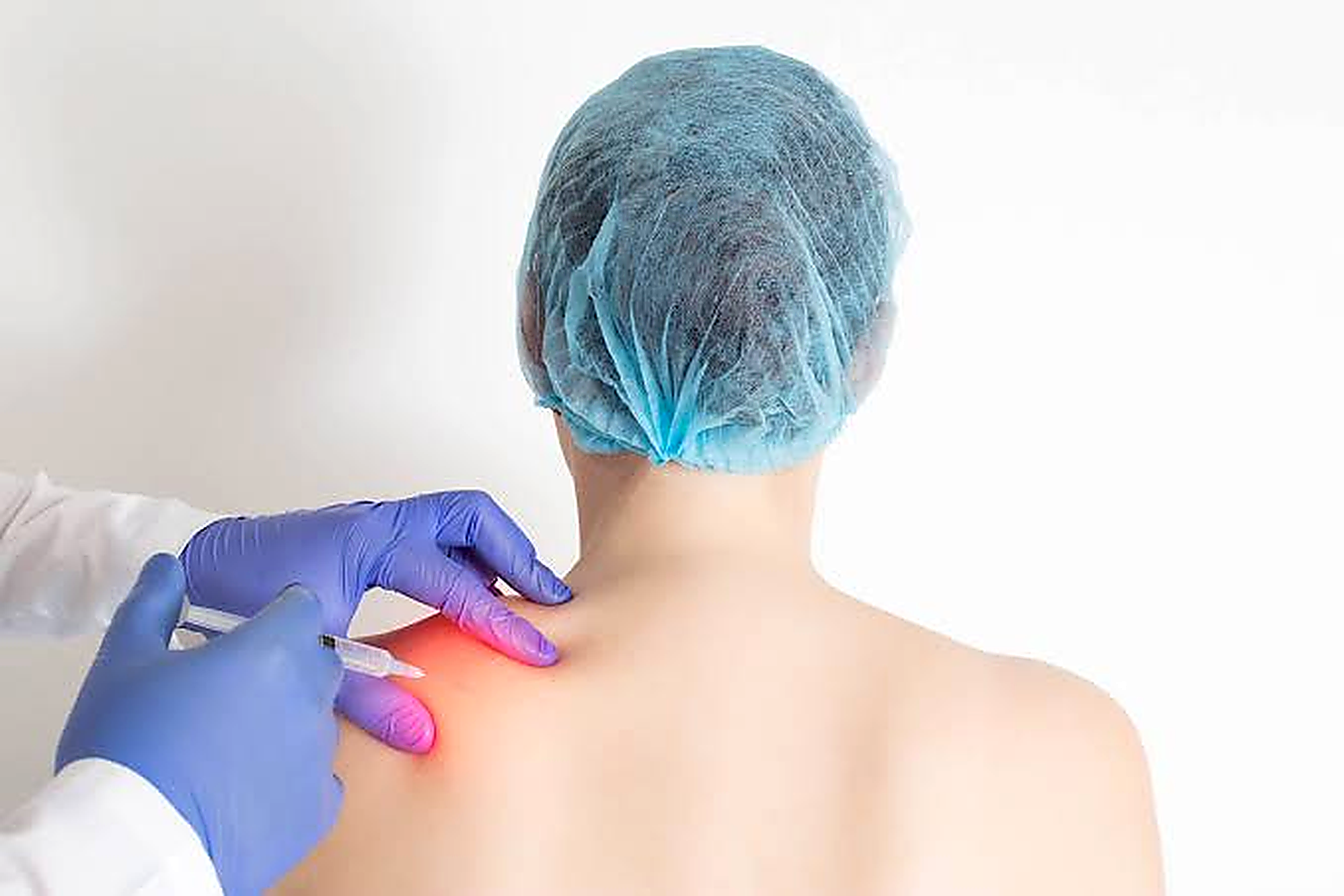
Your surgery was months ago. The scar has healed, and the doctor says everything looks fine. But your shoulder still aches, and nobody can explain why. If that sounds familiar, you’re far from alone. Pain that hangs around after the cause is gone is one of the most frustrating things a person can face.
Some doctors try a different route called neural therapy. It uses tiny injections of numbing medicine placed in very specific spots, like scars and irritated nerves. At Learn Neural Therapy, we train healthcare providers in this method. In this guide, you’ll see what it is, how it works, what research says, and what a visit feels like. Some of the answers are exciting. Others are a reality check, and you deserve both.
What is Neural Therapy?
Neural therapy is a treatment where a trained provider injects a small amount of local anesthetic into chosen spots on the body. The most common choice is procaine, a close relative of the numbing shot you may get at the dentist. The needle goes into scars, irritated nerves, small bundles of nerve cells called ganglia, or sore trigger points.
A quick look at its history
A German chemist named Alfred Einhorn made procaine in 1905. In 1925, brothers Walter and Ferdinand Huneke noticed something odd. Ferdinand gave his nurse a procaine treatment for rheumatism, and her long-running migraines disappeared. Walter spent his career studying why. Doctors in Europe and Latin America have used the method for decades, and it is now growing in the United States.
What goes in the syringe?
Plain procaine, with no added epinephrine or preservatives. Some providers use lidocaine or vitamins instead. Procaine breaks down in the tissue within 15 to 20 minutes, which is one reason many practitioners like it.
How Does Neural Therapy Work?
Scars, nerves & mixed-up signals
After surgery or an injury, a scar can leave nearby nerves irritated. Those nerves may send odd signals to the brain and to the autonomic nervous system, which runs body jobs you never think about, like digestion and blood pressure. Since all nerves are connected, the trouble can show up far from the scar. A belly scar, for example, might be linked to a stubborn shoulder ache. Providers call these trouble spots “interference fields.” That’s a working theory, and scientists are still testing it.
Why a short-acting medicine may last longer
The numbing effect fades in under an hour, yet many patients say relief lasts much longer. Providers think each neural therapy injection calms the irritated nerve and helps the body slide out of “fight or flight” and into “rest and digest.” Repeat visits then build on that calmer starting point.
Neural Therapy vs. Perineural Injection Therapy vs. Prolotherapy
These names get mixed up a lot. The treatments are cousins, not twins.
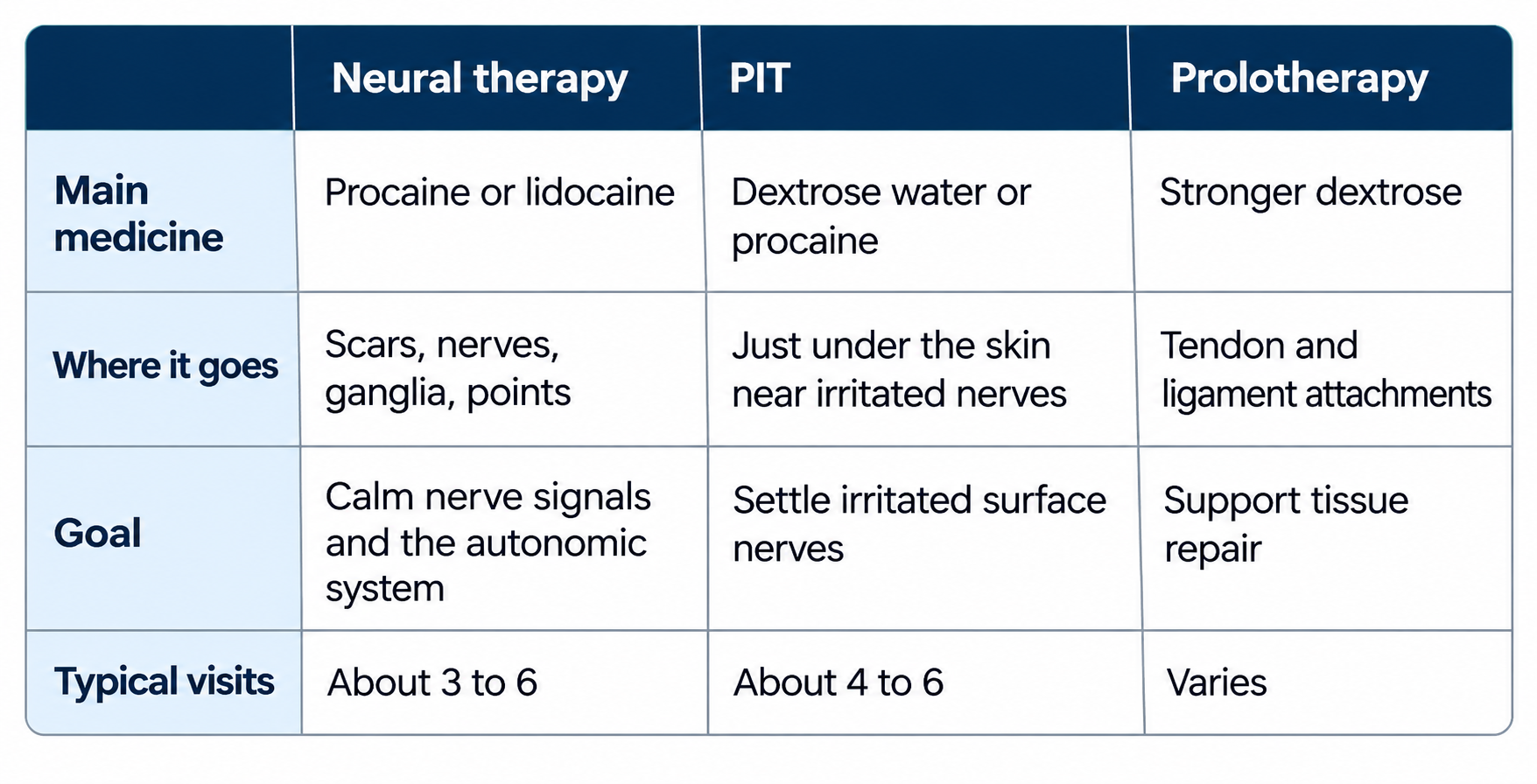
PIT stands for perineural injection therapy. Dr. John Lyftogt developed it, and many clinics use a weak dextrose solution, while some therapists use diluted procaine. Perineural injections like these are usually given in a short series.
How Can Neural Therapy Help With Pain?
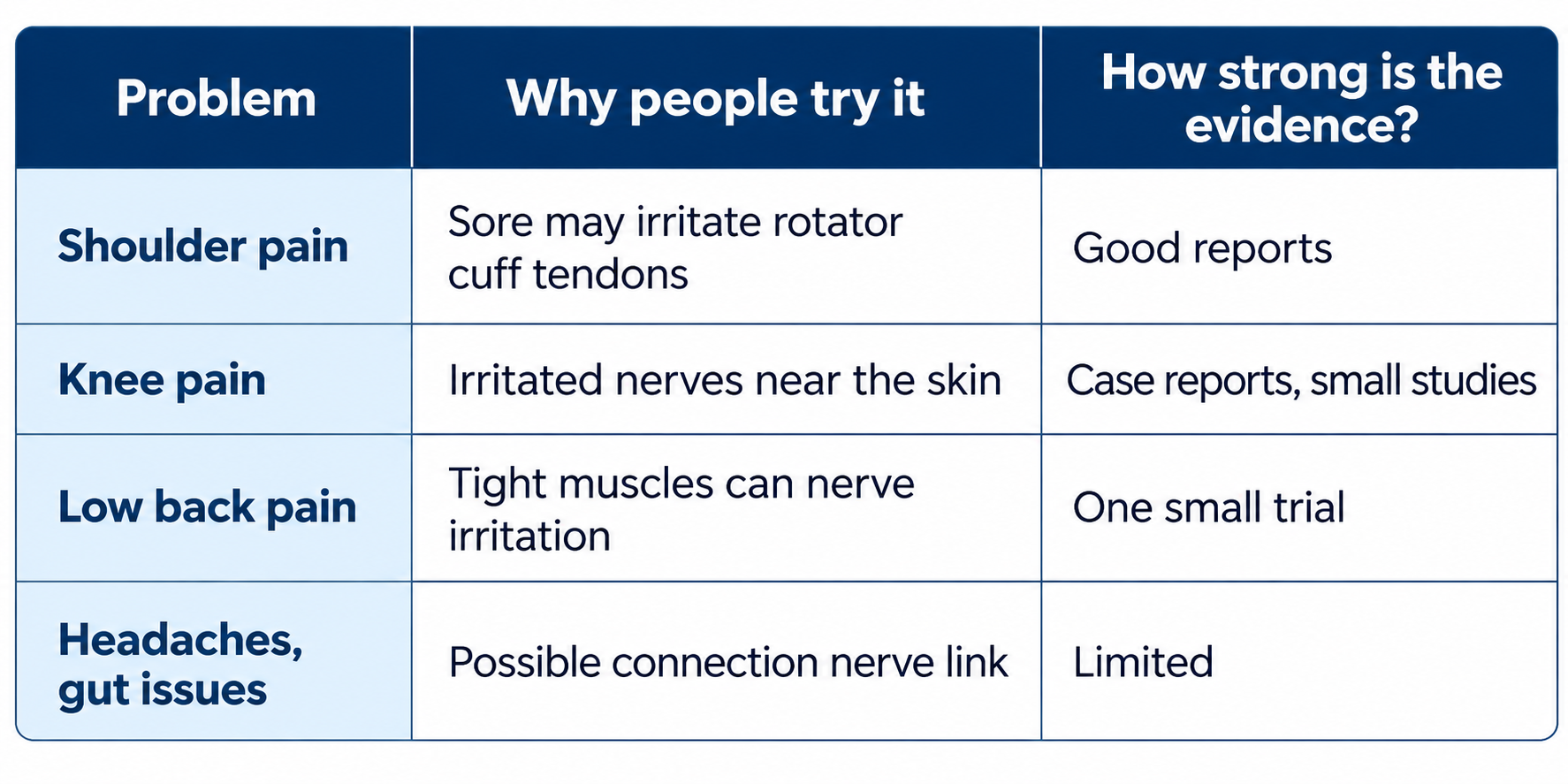
Neural therapy is mostly used for pain that has lasted a long time and hasn’t budged with other care. Here are the areas people ask about most. Keep in mind that many studies are small.
Scar pain
Surgical and C-section scars can stay tender for years. Providers inject in and around the scar to calm the nerves underneath. Patients describe scars that feel softer and less sensitive, though most proof so far comes from case reports.
Nerve pain
Perineural injection therapy places tiny amounts of solution just under the skin near an irritated nerve. Small reports on perineural injections describe relief for jaw nerve pain and for pain that returned after carpal tunnel surgery. One patient’s pain dropped after three visits. A single story proves little, so treat it as a lead, not a promise.
Muscle & joint pain
In one trial of 102 people with low back pain linked to a deep hip muscle, adding neural therapy to stretching eased pain and improved daily movement more than stretching alone.
Some providers also use it for headaches, gut trouble, and tiredness. Those uses have the weakest backing, so ask for proof.
What to Expect During a Session
Your first visit
Expect questions about surgeries, scars, injuries, and allergies. Many providers start with a tiny test dose so you can see how you feel.
Does it hurt?
Most people compare it to a mosquito bite. Sensitive spots and thick scars can sting more, but the area numbs fast.
How many visits?
Often three to six, at about 30 to 45 minutes each. Some people feel better right away. Others feel a bit worse for a day first, or have a rush of emotion.
Possible side effects
Bruising, soreness, and short-term lightheadedness are the most common. Rare risks include infection, allergic reaction, and a punctured lung when a needle goes near the chest. People allergic to anesthetics should skip it. A skilled provider checks for these before every neural therapy injection.
Is Neural Therapy Safe, Proven, or Covered by Insurance?
Done by a trained provider with clean tools, it is considered low risk. “Proven” is trickier. A 2023 review found mostly positive or possibly positive results. But many of those studies were small or loosely designed, and some insurers still call neural therapy investigational. In the U.S., procaine is approved as an anesthetic but not specifically for this use, and most patients pay out of pocket. Talk with your own doctor before you start.
Who Is It For, and How Do You Find a Provider?
Adults with long-lasting pain that hasn’t improved with usual care are the main group who try it. We keep a list of trained practitioners in Oregon, New Mexico, New Hampshire, Vermont, and Vancouver on our site.
If you’re a healthcare provider
Learn Neural Therapy, led by Dr. Anne Hill, ND, and Dr. Ilana Gurevich, ND, LAc, offers in-person and online classes. You can start with Level 1, move on to Level 2 with ganglion work, or take the perineural courses for the upper and lower body.
Lessons cover anatomy, procaine, consent forms, and even billing. MDs, DOs, NDs, NPs, chiropractors, acupuncturists, and dentists with injection scope are all welcome.
In Closing,
Neural therapy is an interesting option for people whose pain won’t quit, especially scar and nerve pain. The research is promising but still growing, so go in with open eyes and a trained provider.
Ready to learn more? Find a practitioner near you. If you’re a clinician, explore the classes at Learn Neural Therapy and bring this tool to your patients. Contact us today to get started.
FAQs
What is neural therapy used for?
Mainly long-lasting pain, scar pain, and nerve pain. Some providers also use it for headaches and digestive issues, but those uses have less research behind them.
What’s the difference between neural therapy and perineural injection therapy?
Neural therapy treats scars, nerves, and ganglia, usually with procaine. PIT focuses on irritated nerves under the skin and uses dextrose.
Does a neural therapy injection hurt?
Usually it feels like a mosquito bite. The numbing medicine works fast, so the sting fades quickly.
How many treatments will I need?
Three to six visits is common. It depends on your condition and how long you’ve had it.
Is neural therapy FDA approved or covered by insurance?
Not for this use, and most insurers call it experimental, so plan on paying yourself.
Are perineural injections safe?
With a trained provider and sterile tools, risks are low. Bruising and soreness are the most common issues. An allergy to anesthetics is a reason to avoid them.