
Perineural Therapy vs Traditional Pain Management: Key Differences
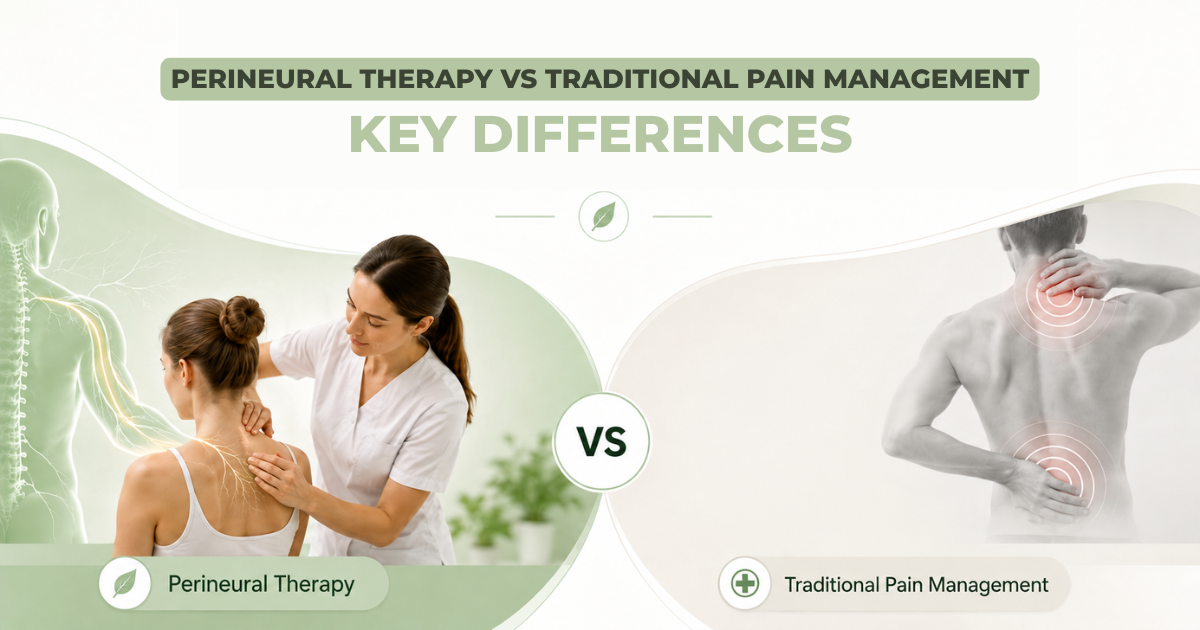
Traditional pain management typically focuses on masking symptoms or reducing global inflammation. At the same time, perineural therapy targets the physical source of neurogenic inflammation to reset the nerve's signaling and promote genuine tissue repair.
The medical landscape is shifting. For decades, the goal of pain treatment was "management," a word that implies living with a burden rather than removing it. As we move into 2026, the focus has pivoted toward regenerative solutions. Understanding the distinction between these two paths is the first step toward reclaiming a life free from chronic discomfort.
What is Perineural Therapy?
Perineural therapy is a regenerative technique targeting inflamed nerves just beneath the skin. When nerves are injured, they release chemicals that cause chronic pain and stall healing. This treatment uses micro-injections of a low-concentration dextrose solution (D5W) to act as a metabolic "reset button." By calming inflammatory signals, it restores the nervous system's electrical balance.
Data from the National Institutes of Health (NIH) confirms that D5W is highly effective. Clinical trials show it provides longer-lasting relief from nerve entrapment than traditional saline or steroid injections. By feeding the "starved" nerve, PIT transitions the body from a state of constant alarm to one of active repair.
What is Traditional Pain Management?
Traditional pain management treats the body's "hardware"—muscles and joints—by suppressing symptoms. This conventional approach uses a "ladder" of treatments, starting with pills like Ibuprofen and progressing to steroid injections or nerve blocks.
While these tools provide temporary relief for injuries, they focus on silencing the pain signal rather than fixing the underlying nerve dysfunction. Essentially, it relieves pain rather than addressing the cause.
Mechanism: Why These Work Differently
Traditional pain management and perineural therapy differ in their biological goals.
Traditional methods use steroids to shut down the immune response. While powerful, these are "catabolic," meaning they can weaken tissue over time. It is like silencing a fire alarm while the embers are still burning; the noise stops, but the danger remains.
In contrast, perineural therapy uses a low-dose dextrose solution to "feed" irritated nerves. When nerves are stressed, they become stuck in a state of constant pain signaling. Dextrose acts as a reset button by targeting TRPV1 receptors and blocking pain-causing chemicals such as Substance P.
Instead of just masking symptoms, this approach transitions the nerve from "alarm" to "repair." By calming these pathways, the body returns to its natural balance, promoting genuine, long-term healing rather than temporary suppression.
Comparing Both Side by Side
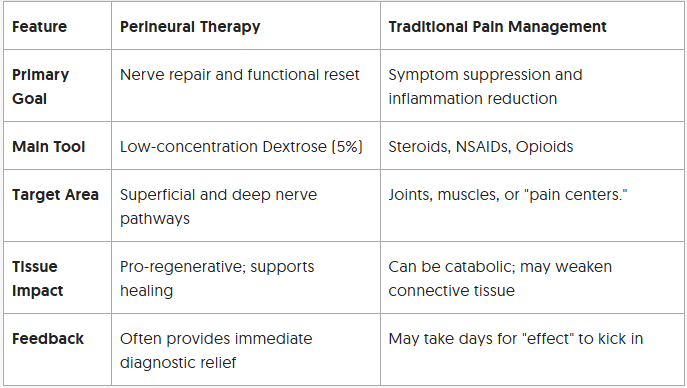
Primary Treatment Philosophy
Traditional pain management focuses on intervention and suppression. It treats pain as an enemy to be silenced through chemical or surgical means. In contrast, perineural therapy views pain as a signal of nerve distress. It seeks to rehabilitate the nerve rather than silence it, making it a "bottom-up" approach to healing.
Chemical Composition and Biological Impact
Traditional methods often utilize corticosteroids or heavy analgesics. While these provide relief, steroids can weaken tendons and ligaments over time. Perineural therapy utilizes a 5% dextrose solution. This is a pro-regenerative substance that supports the nerve's metabolic needs, making it a safer long-term option for maintaining structural integrity.
Target Specificity and Accuracy
Standard treatments often target large areas, like a "shot in the knee" or a "general nerve block." Because perineural therapy targets the specific pathways of neurogenic inflammation, the injections are highly specific. This precision allows providers to identify the exact "short circuit" in the body's electrical system.
Duration of Results and Cumulative Healing
Traditional pain management only masks symptoms, so pain returns when the medication wears off. Perineural therapy is different; it heals nerves over time. Research shows that for Carpal Tunnel, dextrose injections provide better long-term relief and mobility after six months than traditional steroids, leading to lasting recovery rather than just temporary comfort.
What Conditions Perineural Therapy Addresses
Perineural therapy is exceptionally effective for conditions where "neurogenic inflammation" is the culprit. This includes:
Chronic neck and back tension
Tennis or Golfer's elbow
Knee pain (especially post-surgical or "bone on bone" sensations)
Carpal tunnel and other nerve entrapments
Complex Regional Pain Syndrome (CRPS)
Achilles tendonitis and plantar fasciitis
By restoring the "glide" to the nerves in these areas, the therapy allows for a return to a full range of motion without the sharp, stabbing pains associated with nerve constriction.
What Conditions Traditional Pain Management Addresses
Traditional methods remain the gold standard for:
Acute fractures and traumatic injury
Severe rheumatoid arthritis flares
Post-operative pain control
End-of-life care and palliative comfort
Structural abnormalities that require surgical intervention
While these methods are vital, they are often used as a permanent crutch for functional issues that could be resolved through the more precise approach of therapy.
Which One is Safer?
Perineural therapy is exceptionally safe because it uses a simple 5% dextrose (sugar) solution instead of harsh drugs. Unlike steroids, it won't weaken tissue or disrupt hormones. According to the National Institutes of Health (NIH), it is safe even during pregnancy or for patients with implants. It avoids the risks of dependency and promotes natural, sustainable healing without systemic side effects.
Master the Art of Healing with Learn Neural Therapy
The future of medicine isn't just about living with less pain; it's about restoring the body's innate ability to heal.
At Learn Neural Therapy, we provide the world-class training you need to become one of the leading neural therapy providers in your field. Our expert-led courses offer:
In-Person Classes: Hands-on training for upper and lower extremity injections.
Virtual Learning: Master the science of perineural therapy from the comfort of your own clinic.
Expert Resources: Deep dive into our podcast, "The Point of Medicine," and our YouTube demonstrations.
Whether you are looking to treat complex pelvic pain or simple sports injuries, our certification programs give you the precision tools to change patient outcomes. Don't just manage pain; reset the system.
Download our Clinical Protocol Guide for Dextrose Prolotherapy to see how to integrate this into your practice today. Visit Learn Neural Therapy today!
FAQs
How quickly will I feel relief after a Perineural Injection?
Immediate results. Many patients report a significant "reset" of pain within seconds or minutes. However, multiple sessions are often needed for permanent results.
How many sessions of PIT are typically required?
Most patients see lasting resolution after 6 to 10 weekly sessions, depending on the chronicity of the nerve irritation.
Does 5% dextrose injection hurt?
Pain anxiety. The treatment uses very fine needles for superficial injections. While you may feel a small "pinprick," the solution itself is often combined with a local anesthetic for comfort.
Can I drive or work immediately after the treatment?
Yes. Unlike heavy nerve blocks, PIT is minimally invasive with no downtime, making it ideal for busy professionals.
Is Perineural Therapy safe during pregnancy?
Yes. Because it uses a simple sugar solution naturally found in the body, it is a preferred alternative for patients who cannot use steroids or NSAIDs.